Share This Article
Artificial intelligence is moving beyond chatbots, search and enterprise software. One area where it could have a significant real-world impact is climate technology, where there is a growing need to rapidly and accurately analyze large amounts of environmental and geospatial data.
You can see that shift in Google’s latest Google DeepMind Accelerator initiative. Google has selected four Indian organizations — Terrastack, Varaha Climate, Farmers for Forests and Climitra Carbon — for its first-ever AI for the Planet (APAC) accelerator.
The four Indian organizations are among 16 organizations from across the Asia-Pacific region. The program aims to help organizations use advanced AI to address challenges related to climate, agriculture, biodiversity and nature.
Table of Contents
Four Indian Startups Join AI for the Planet to Tackle Environmental Challenges
The selection underscores the growing potential of climate tech startups in India, especially those combining artificial intelligence with satellite imagery, drones and geospatial data.
Terrastack focuses on agriculture, providing plot-level land intelligence using satellite and agronomic data. The aim is to give farmers more useful information about their land and support better agricultural decision-making.
Varaha Climate operates at the intersection of regenerative agriculture and carbon removal. Its technology uses remote sensing and artificial intelligence to verify climate-related activities, helping smallholder farmers participate in carbon-credit markets.
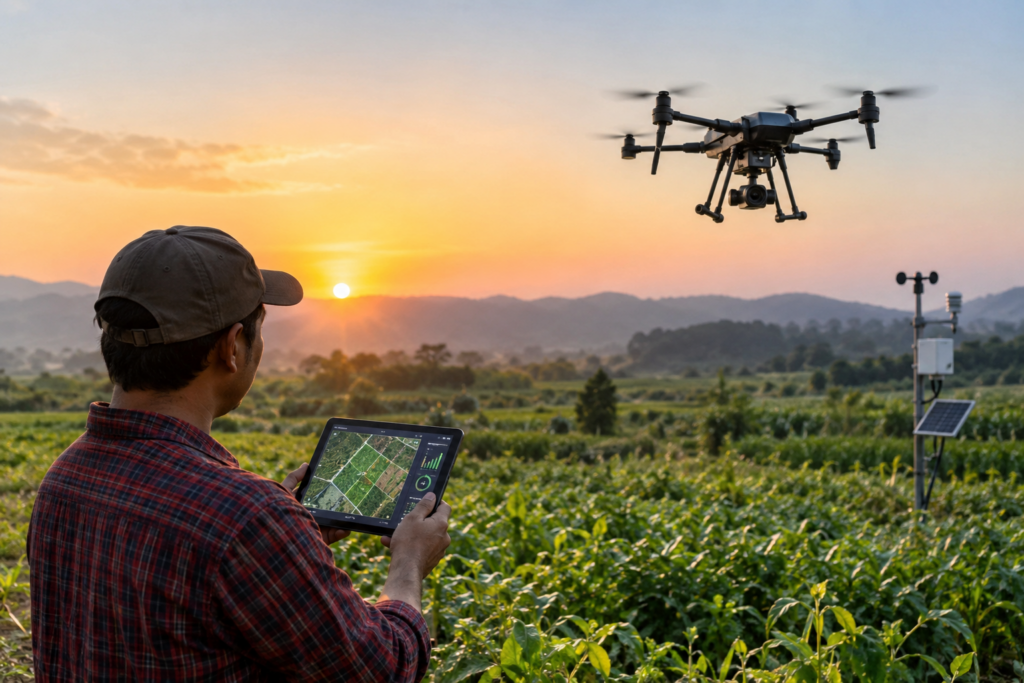
Farmers for Forests uses AI-powered drones and spatial data to quantify the results of agroforestry. Its work focuses on measuring carbon and biodiversity impacts, areas where accurate measurement can be difficult to achieve at scale.
Climitra Carbon is taking a geospatial approach to carbon removal. The company applies Geo-AI to verify the removal of invasive vegetation and connect the resulting biomass with biochar production.
Together, these companies demonstrate how AI for climate change can be applied to real-world challenges across farms, forests and other landscapes.
How AI Is Becoming Critical for Climate Tech
Climate and environmental projects generate huge amounts of data. Satellites can monitor changes across large areas, while drones, sensors and field teams can provide more detailed information from specific locations.
Turning all that data into useful insights, however, can be challenging.
This is where AI in climate technology can play an important role. Machine learning algorithms can identify patterns in satellite imagery, track vegetation, assess agricultural conditions and support the verification of environmental projects.
For companies working in carbon markets and nature-based solutions, reliable measurement is particularly important. Better data can make it easier to track environmental outcomes and potentially increase confidence in climate projects.
This is the opportunity on which Google’s accelerator is built, giving participants access to technical expertise and AI tools that can help them further develop their solutions.
What Google Is Offering Selected Organizations
The Google DeepMind Accelerator emphasizes technical support and mentorship over traditional startup funding.
Participants will have access to Google’s AI stack, along with technical guidance and support from Google experts throughout the three-month program. The initiative kicked off in Singapore with an in-person bootcamp and is scheduled to conclude with a Demo Day in December 2026.
Participants will also have the opportunity to work with specialized AI technologies from Google’s ecosystem, including AlphaEarth Foundations, ForestCast, SpeciesNet, Perch and AnthroKrishi.
For Indian startups building climate-tech solutions, access to this kind of technical expertise could be valuable. Developing AI systems for environmental applications often requires specialized datasets, geospatial expertise and significant technical experimentation.
A Sign of India’s Growing Climate-Tech Opportunity
The selection of four Indian organizations is also significant as India’s climate-tech ecosystem continues to move beyond traditional renewable-energy companies.
Startups are increasingly working in areas such as regenerative agriculture, carbon removal, biodiversity monitoring, forest restoration and climate intelligence. Many of these challenges are highly data-intensive, making them natural candidates for AI-powered solutions.
In India, where agriculture and natural ecosystems span vast and diverse geographies, the combination of AI and geospatial technology could be particularly relevant.
The development also presents a broader opportunity for founders: AI does not necessarily have to be the final product. It can serve as a fundamental technology that improves how industries collect, analyze and use information.
What Happens Next?
Over the coming months, the four organizations selected for AI for the Planet will work with Google’s technical teams and AI technologies. The results of this work could provide greater insight into how advanced artificial intelligence can be used to address real-world climate and environmental challenges.
The program itself lasts only three months, but its potential impact could extend beyond the participating organizations. If AI can make environmental monitoring more accurate, scalable and affordable, it could influence how future climate projects are developed and measured.
The participation of Terrastack, Varaha Climate, Farmers for Forests and Climitra Carbon also represents another sign that India’s AI opportunity is expanding into increasingly specialized industries.
Ultimately, the Google DeepMind Accelerator selection highlights an important trend: the next generation of AI startups may not only build software for businesses or consumers. Some may use AI to better understand farms, forests, biodiversity and the planet itself.