Share This Article
Full-service agencies face a hosting decision that most comparison articles are not equipped to address. The typical roundup evaluates providers through the lens of individual site owners, comparing introductory pricing, storage allotments, and basic benchmarks that barely scratch the surface of what agencies need. For organizations managing diverse client portfolios while juggling design, development, marketing, and maintenance, the evaluation criteria look fundamentally different.
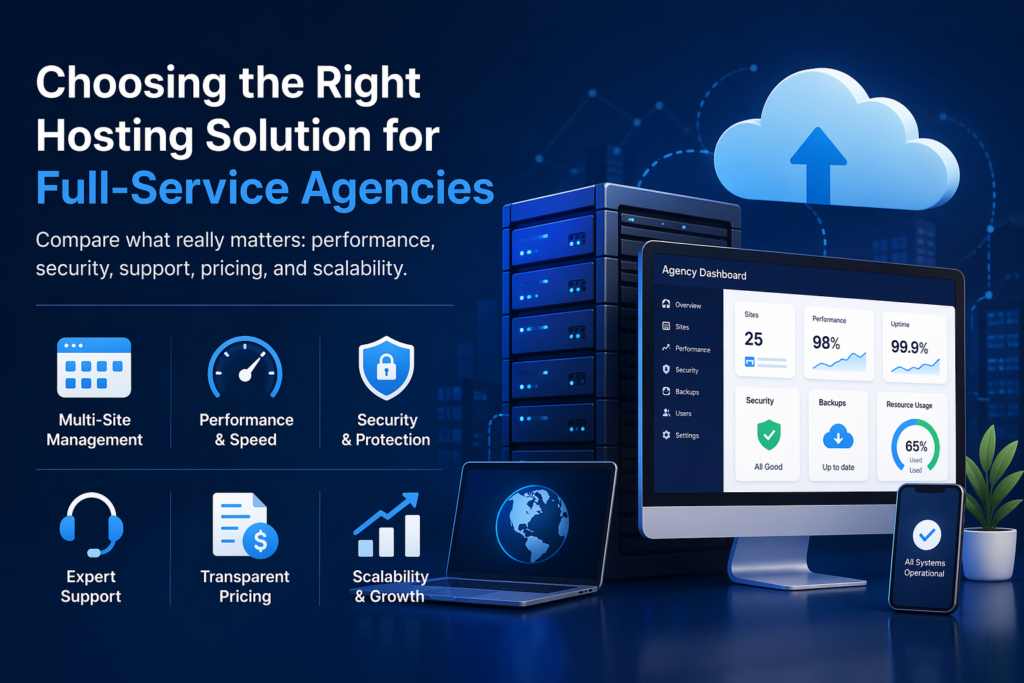
Comparing hosting options effectively requires evaluating providers against the specific operational demands that define agency reality. Speed matters, but so does multi-site management. Security matters, but so does how uniformly it applies across dozens of domains. Here is how leading options stack up when evaluated through the lens that full-service agencies actually care about.
Table of Contents
Multi-Site Management: The First Dividing Line
The sharpest distinction between hosting options emerges in how they handle multiple domains. Some providers offer multi-site capabilities as genuine core functionality, with centralized dashboards offering portfolio-wide visibility, bulk action tools, and per-domain resource management. Others technically permit multiple domains but treat them as an extension of single-site tools, offering little more than a list of accounts managed individually.
Agencies should test beyond marketing language. Key questions to ask include:
- Can updates deploy across every domain in a single action?
- Does the dashboard aggregate performance, security, and backup data meaningfully?
- Is resource allocation configurable per domain, or does every site share an undifferentiated pool?
These answers separate platforms designed for portfolio management from those that simply allow it.
Performance Infrastructure: Depth Over Headlines
Every provider claims fast performance. The difference for agencies lies in the depth and consistency of the infrastructure delivering that speed. Leading options distinguish themselves through multi-tiered server-level caching, current PHP management, database engines tuned for CMS workloads, and native CDN integration that is pre-configured rather than left as manual setup.
Where comparisons become especially revealing is under load. A provider might deliver excellent single-site benchmarks but struggle when multiple domains experience concurrent traffic surges. Agencies should seek performance data from multi-site testing scenarios and pay attention to how resource isolation protects individual domain speeds when neighboring properties are under pressure. Consistent performance across a diverse portfolio matters far more than peak speed on a single test site.
Security: Platform-Level Versus Piecemeal
Security comparisons often focus on feature lists, such as whether the provider includes a firewall, malware scanning, or SSL certificates. For agencies, the more critical question is how those features are implemented. Platform-level security applying uniformly across every hosted domain is fundamentally different from security requiring individual plugin installations on each property.
Leading options provide the following as infrastructure-level features covering the entire portfolio by default:
- Server-managed firewalls
- Automated threat detection
- Brute force protection
- SSL certificate management
Conducting your own Bluehost agency hosting review by testing the platform against these security criteria through the lens of agency workflows will reveal whether protection is structural or piecemeal, a distinction that matters more as the portfolio grows.
Support: Technical Fluency Under Pressure
Support comparisons typically measure response time and channel availability. Agencies need to evaluate a deeper dimension, which is whether the support team can handle multi-site environments, server-level diagnostics, and deployment workflow troubleshooting. A provider offering twenty-four-hour live chat means little if agents can only assist with basic WordPress questions.
The most meaningful comparison point is resolution quality on complex issues. Providers staffing support teams with engineers experienced in multi-site operations resolve agency-level problems on first contact. Those relying on scripted first-tier agents create escalation cycles that waste hours when speed matters most. Testing support with a technical question during trial periods provides more useful data than any published response time guarantee.
Pricing: Total Cost of Ownership
Introductory pricing dominates most comparisons but tells agencies almost nothing about long-term cost. The meaningful comparison examines total cost of ownership: what the agency pays after promotional periods end, which features are included versus billed separately, and how pricing scales as domains are added.
Leading options offer transparent pricing with essential features bundled as standard. Backups, SSL, staging environments, and security tools should not appear as surcharges on top of the base plan. Equally important is whether adding domains triggers proportional cost increases or requires migrating to entirely different tiers with unpredictable rate adjustments.
Scalability and Growth Readiness
The final comparison dimension is forward-looking. Can the platform accommodate portfolio growth without disruptive migrations? Does resource scaling happen fluidly based on demand, or does it require manual upgrades with downtime? Is the provider investing in platform innovation, such as new features, improved tooling, and updated infrastructure, or has development stagnated?
Agencies making long-term infrastructure commitments need providers demonstrating both current capability and a trajectory of continuous improvement.
Comparison as a Strategic Exercise
Comparing hosting options for full-service agencies is not a matter of reading feature checklists and choosing the lowest price. It is a strategic evaluation weighing multi-site management depth, performance consistency, security implementation, support competence, pricing transparency, and growth readiness as interconnected factors. The provider scoring highest across these dimensions, not just on any single metric, is the one most likely to support operations reliably for years to come. The time invested in thorough comparison pays dividends every day the agency operates on a platform that genuinely fits how it works.