Share This Article
For nearly three decades, the internet operated on one core assumption: when you need an answer, you search for it. Google became the undisputed gateway to human knowledge. Need investment advice? Search Google. Need a software recommendation? Search Google. Need to learn SEO, launch a business, compare products, plan a trip, or troubleshoot a technical issue? Search Google.
This habit was so ingrained that “Google” became a verb for an entire generation.
But something profound has shifted in the last two years. For the first time since modern search engines emerged, millions of people no longer begin their information journeys on Google. They start with AI.
This behavioral pivot—from traditional search to conversational AI—may be one of the most significant transformations in internet history. While headlines focus on AI-generated images, viral chatbots, massive funding rounds, and job displacement fears, a quieter revolution is reshaping how humans think, research, learn, decide, and interact with information.
In this in-depth analysis, we draw from the latest 2025–2026 public AI adoption studies, enterprise reports, workplace research, developer surveys, search behavior trends, and usage data from leading AI companies to reveal what millions of real AI conversations actually show about human behavior in 2026.
Table of Contents
The Explosive Growth of AI Adoption in 2026
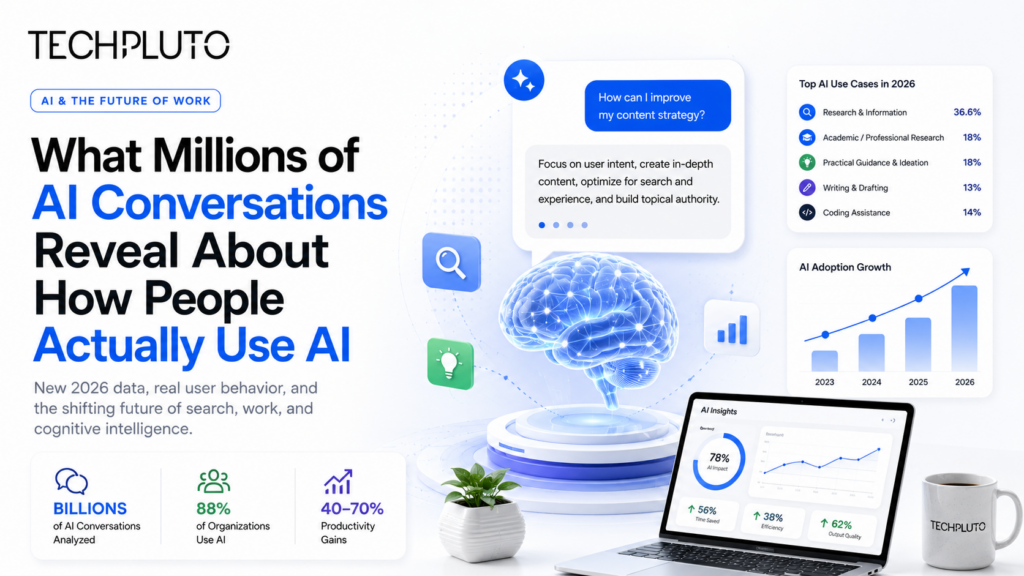
AI adoption has accelerated from experimental to mainstream. McKinsey’s 2026 research shows that 88% of organizations now use AI in at least one business function, up significantly from prior years. Generative AI usage in organizations reached 79% in 2025 and continues climbing.
At the individual level, more than one-third of people across the OECD used generative AI in 2025, with strong momentum carrying into 2026. ChatGPT processes billions of queries daily and maintains hundreds of millions of active users. Global adoption varies widely: countries like India, the UAE, Singapore, and China lead, while others lag.
Key 2026 Adoption Statistics:
- OECD firms using AI: 20.2% (more than doubled since 2023).
- EU enterprises: 19.95% AI usage.
- Large organizations (5,000+ employees): up to 83% adoption.
- Knowledge workers using AI: 75% in many surveys.
This scale confirms AI is no longer niche—it’s fundamentally altering daily information-seeking behavior for hundreds of millions worldwide.
What Millions of Real AI Conversations Actually Reveal
Analyses of actual user interactions cut through the hype. Content generation grabs attention, but practical cognitive support dominates real usage.
Top ChatGPT Use Cases in 2026:
- General Research: ~36.6%
- Academic/Professional Research: ~18%
- Practical Guidance & Ideation (tutoring, how-to, planning): Leading category
- Writing & Drafting (emails, documents, editing): High volume
- Seeking Information (products, recipes, events): Significant share
- Coding Assistance & Debugging: ~14%
OpenAI’s studies show nearly half of interactions fall under “Asking” (seeking advice or information), 40% under “Doing” (task completion), and 11% under “Expressing” (reflection and exploration). People value AI most as an intelligent advisor and thinking partner rather than just a content factory.
In workplaces, common applications include customer service (56%), IT operations (51%), marketing/sales support, message responses (45%), financial questions (43%), travel planning (38%), and job preparation (30%). Developers use AI heavily for learning, documentation, and code acceleration.
Users increasingly maintain personalized toolkits—averaging 1.5+ platforms—combining strengths of ChatGPT for versatility, Claude for deep reasoning, and others for specialized tasks.
The Paradigm Shift: From Google Search to AI Conversations
Traditional search still commands massive volume (Google at ~13.7 billion daily searches), but AI tools are rapidly capturing complex, conversational queries. In 2026, many users now start with AI assistants for nuanced needs.
Google has responded aggressively with major AI overhauls, including conversational modes and agents, marking its biggest Search transformation in 25+ years. Yet the trend toward dialogue-based interfaces continues. Queries are becoming longer, more natural, and context-rich as users adapt to AI habits.
Hybrid behavior is common: AI for synthesis and rapid insights, traditional search for source verification and discovery. This evolution signals a deeper change—from passive link retrieval to active, interactive knowledge co-creation.
Cognitive Acceleration: How AI Is Reshaping Human Thinking
The most consequential insight from millions of conversations is cognitive acceleration. People use AI not just to create faster, but to think differently—offloading routine mental tasks to amplify higher-order abilities like strategy, creativity, and judgment.
Documented Productivity Impacts:
- Knowledge workers save 40–60 minutes daily with AI access.
- Efficiency gains of 40–70% in augmented tasks.
- Home “digital chores” (planning, shopping, job hunting) see 76–176% productivity boosts.
- Novice and mid-level performers often gain the most, compressing skill gaps.
AI serves as a tireless tutor, debate partner, scenario simulator, and research synthesizer. This enables faster iteration, broader option exploration, and more structured thinking.
However, balanced analysis reveals risks. Over-reliance can cause cognitive offloading, reduced critical thinking, and “brain fry” from constant verification. Some studies note potential declines in divergent creativity or unassisted performance. The outcome depends heavily on how AI is used: as a collaborative multiplier versus a passive crutch. Intentional users—who prompt critically, challenge outputs, and maintain core skills—achieve the greatest hybrid intelligence gains.
Enterprise AI in 2026: Scaling Wins and Persistent Challenges
Despite 88% organizational adoption, true enterprise scaling remains difficult. Only about one-third of companies have moved beyond pilots to broad deployment. High performers (often larger firms) invest heavily in governance, data quality, and integration, seeing clearer ROI and productivity lifts.
Barriers to Scaling in 2026:
- Skills and talent gaps
- Data quality and integration issues
- Governance and risk management
- Measuring true business impact
- Organizational readiness and change management
Leaders who treat AI as a strategic transformation—reimagining workflows, not just automating tasks—capture the strongest results, including revenue growth and competitive advantage.
Broader Societal and Individual Implications
This shift from search to AI dialogue is reshaping education, decision-making, creativity, and economic opportunity. Personalized learning accelerates, but new divides emerge between AI-fluent individuals/regions and others. Policy, education systems, and businesses must prioritize prompting skills, critical verification, ethical use, and cognitive health alongside technical access.
Economically, AI is projected to drive trillions in global value, but benefits concentrate among early scalers and high-adoption areas. The winners in 2026 and beyond will master AI as a cognitive partner: using it to explore more ambitiously while preserving human judgment and originality.
Conclusion: The Real AI Revolution Is Behavioral
Data from millions of AI conversations in 2026 delivers a clear message. The biggest use case isn’t flashy content generation—it’s cognitive acceleration. People are using AI to research deeper, learn faster, decide smarter, and solve problems more creatively.
We are witnessing the early stages of a new human-AI symbiosis. The internet’s next chapter isn’t about superior search results. It’s about superior thinking—augmented by intelligent systems yet firmly driven by human wisdom, curiosity, and ethics.
As adoption matures, the critical question becomes: Will we use this powerful technology to amplify our potential or diminish our capabilities? The conversations happening with AI today are quietly writing the answer.
Organizations and individuals who approach AI thoughtfully—as a collaborator for better thinking rather than a replacement—will thrive in this new era. The behavioral revolution is already here, and its full impact will define the decade ahead.