Share This Article
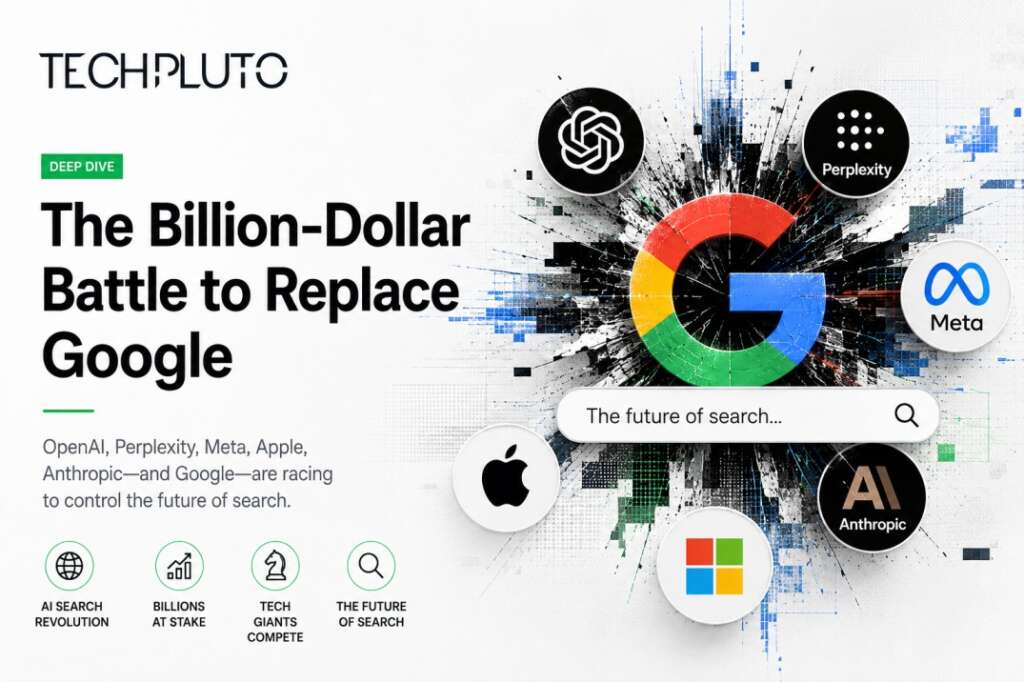
The Billion-Dollar Battle to Replace Google is one of the most critical technology shifts happening in 2026. For over two decades, Google dominated as the internet’s primary gateway. Today, powerful AI challengers are redefining how people discover, consume, and act on information.
This isn’t just another search engine competition. The Billion-Dollar Battle to Replace Google represents a fundamental transformation in information access, driven by trillion-dollar companies racing to control the future of discovery.
Table of Contents
How Search Evolved — And Why It’s Breaking
Traditional search was simple: type a query, scan ten blue links, click through, and dig for answers. Google perfected this model, turning “search” into a verb and building a massive advertising empire on user clicks and site visits.
AI has shattered that paradigm. Users now demand direct answers, intelligent summaries, natural conversations, personalized recommendations, and proactive context — all without leaving the interface. This behavioral shift strikes at the heart of Google’s revenue model, where clicks fuel hundreds of billions in annual ad income.
In The Billion-Dollar Battle to Replace Google, the prize isn’t just better results. It’s becoming the default interface between humans and all knowledge.
OpenAI Ignites the Revolution
OpenAI launched the spark with ChatGPT in late 2022. What started as a chatbot quickly evolved into a go-to information tool. By 2025, OpenAI rolled out broadly available ChatGPT Search, delivering real-time web data through conversational experiences.
Users began asking complex questions like “Compare the best laptops under $1000 for video editing” or “Plan a 7-day trip to Japan with budget options” and received synthesized, actionable responses instead of link lists.
This change is profound. In The Billion-Dollar Battle to Replace Google, OpenAI proved people prefer conversational discovery over traditional navigation. ChatGPT now processes hundreds of millions of queries weekly, with search features driving significant engagement.
Google’s Counteroffensive: Defending the Throne
Google wasn’t caught off guard. Many AI breakthroughs originated in its labs. However, protecting its search advertising cash cow created internal tension.
In response, Google accelerated Gemini integration, AI Overviews, and major Search upgrades. At Google I/O 2026, the company announced its biggest Search overhaul in 25 years — expanding the search box for longer, multimodal queries and introducing AI agents that act autonomously.
AI Overviews now reach over 2 billion monthly users, while the Gemini app approaches 750-900 million monthly actives. Google still commands roughly 80% of traditional search volume, but it is aggressively evolving to make “Google Search is AI Search” a reality.
The Billion-Dollar Battle to Replace Google has forced the incumbent to reinvent its core product before challengers erode its dominance further.
Perplexity: The AI-Native Disruptor
Perplexity emerged as one of the most dangerous challengers in The Billion-Dollar Battle to Replace Google. Focused purely on AI-powered search, it delivers summarized answers with clear citations, conversational follow-ups, and research-friendly workflows.
Perplexity’s valuation skyrocketed from around $500 million in early 2024 to $20 billion by late 2025, with some reports pushing toward $22 billion in 2026. It processes hundreds of millions of queries monthly and boasts tens of millions of active users.
Unlike legacy engines, Perplexity feels like an intelligent research assistant. Its model-agnostic approach and focus on transparency give it strong appeal among power users and professionals.
Anthropic’s Enterprise Power Play
Anthropic entered The Billion-Dollar Battle to Replace Google through a different path. Claude excels in coding, deep reasoning, research, and professional workflows, earning massive enterprise adoption.
Anthropic’s valuation has soared dramatically, reaching reports of $965 billion after major funding rounds in 2026. This reflects investor bets on reliable, safety-focused AI systems becoming central to information infrastructure.
As businesses and individuals increasingly consult AI assistants first, power shifts from traditional search engines toward sophisticated AI platforms.
The Broader Battlefield: Meta, Apple, and Microsoft
The competition extends far beyond a few players:
- Meta embeds AI deeply across social platforms for discovery and recommendations.
- Apple integrates intelligence into devices and Siri for seamless, on-device experiences.
- Microsoft powers Bing and Copilot, leveraging enterprise relationships and Azure infrastructure.
Combined, these giants represent trillions in market value, all fighting for control over how humanity accesses knowledge.
Explosive Growth of AI Search
AI search adoption is accelerating faster than most realize. Platforms like ChatGPT, Claude, Perplexity, Gemini, and Grok handle billions of interactions monthly. AI-first queries are growing at triple-digit rates in many segments.
While Google maintains dominance in traditional search, user habits are shifting. Many now default to conversational AI for research, comparisons, planning, and learning.
Discovery vs. Mere Search
The Billion-Dollar Battle to Replace Google is ultimately about discovery, not just search. Traditional engines help users find information. AI systems help users consume and act on it directly.
This shift enables AI agents that don’t just answer but complete tasks: researching flights, building itineraries, comparing products, and even initiating actions. Search becomes proactive and agentic.
Reddit’s Unexpected Rise
An surprising beneficiary has been Reddit. As AI-generated content floods the web, users crave authentic human experiences and discussions. Google surfaces Reddit threads more prominently, and partnerships provide valuable real-world data for training AI models.
This highlights a key truth: the future of quality discovery will blend AI synthesis with trusted human conversation.
Challenges for Publishers and Content Creators
Publishers watch nervously as AI summaries reduce clicks to original sources. Studies show AI-powered results can significantly impact site traffic. The open question remains: how will creators sustain quality content production when AI systems answer questions directly?
This tension may define internet economics for years to come.
Google’s Enduring Strengths
Despite the pressure, Google retains massive advantages in The Billion-Dollar Battle to Replace Google:
- Unparalleled infrastructure and data scale
- Android and Chrome distribution dominance
- Billions of daily users
- Deep advertising networks
- World-class AI talent
Its ability to integrate AI seamlessly into existing behaviors keeps it as the frontrunner for many analysts. However, the market has irreversibly changed.
What the Future Holds
The future of search may barely resemble today’s version. Expect more multimodal inputs (voice, images, video), AI agents handling complex multi-step tasks, personalized proactive assistance, and deeper integration across devices and platforms.
The Billion-Dollar Battle to Replace Google will determine not just who wins market share, but what information people see, which businesses thrive, which creators succeed, and which narratives spread.
Why This Battle Matters to Everyone
This competition shapes the future of the internet itself. Control over discovery influences commerce, education, politics, innovation, and culture.
Whether the ultimate winner is Google, OpenAI, Perplexity, Anthropic, Meta, Apple, or an unexpected disruptor, one outcome is certain: information access will become more intelligent, conversational, and action-oriented than ever before.
The Billion-Dollar Battle to Replace Google is still unfolding, but its impact will be felt for decades. The companies investing heavily today are competing to become the primary gateway to human knowledge in the AI era.
As users, creators, and businesses, staying informed and adaptable will be key to thriving in this new landscape of discovery. The next chapter of the internet is being written right now — through conversational interfaces, intelligent agents, and AI-powered understanding.