Share This Article
AI-generated image
Digital businesses are increasingly facing a problem that is difficult to detect with traditional analytics: not every visitor is a unique, legitimate user.
One person can have multiple accounts, repeatedly take advantage of promotional offers, share a paid account, or use a VPN, proxy, or anti-detect browser to access a service. That activity can distort traffic data and create financial and security risks for SaaS companies, marketplaces, fintech platforms, and other online businesses.
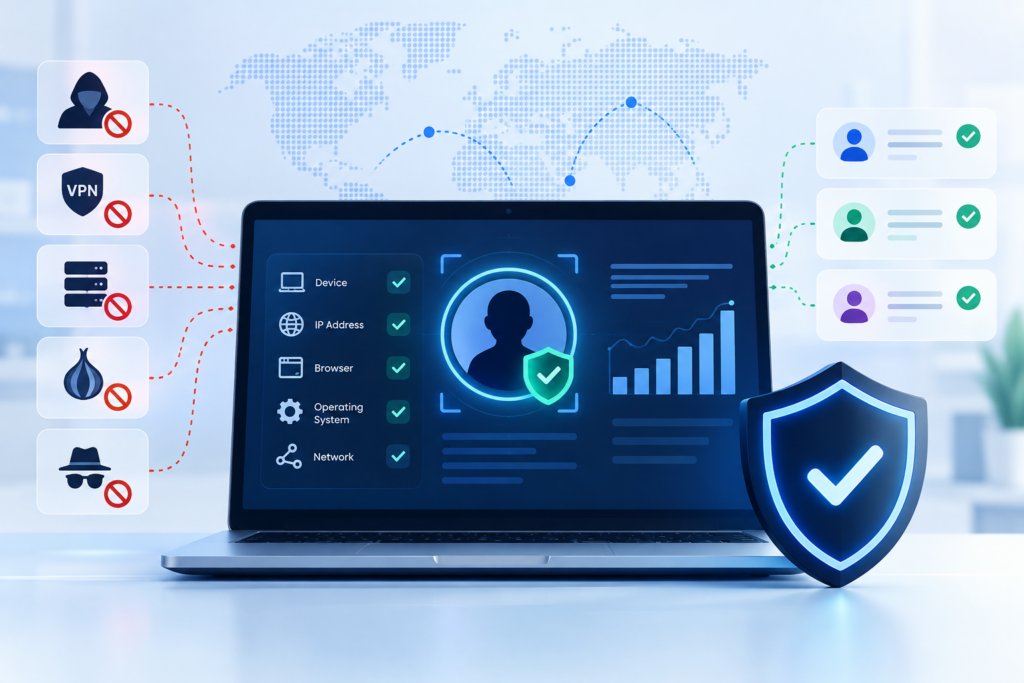
Launched in 2026, SaaS company ShieldLabs is building a visitor identification and abuse-prevention platform designed to give businesses more visibility into those signals. Instead of relying on cookies or a single identifier, the platform analyzes signals across devices, browsers, operating systems, IP addresses, and networks and turns them into an explainable risk score.
Table of Contents
What ShieldLabs Can Do
ShieldLabs describes itself as a visitor identification and anonymous-traffic detection platform. Its goal is to help teams understand the quality of their traffic while identifying patterns that may indicate abuse or fraud.
The platform says it collects more than 100 signals across device, browser, operating system, IP, and network layers. These include indicators associated with VPNs, proxies, Tor, privacy relays, anti-detect browsers, IP reputation, geolocation mismatches, and other forms of anonymized traffic.
Those signals are combined into a risk score from 0 to 100. Rather than automatically deciding what happens to a visitor, ShieldLabs provides the risk score and the underlying signals, while the customer’s own application determines whether to allow, challenge, or block the visitor.
That’s an important part of the product’s positioning: ShieldLabs provides the detection layer, while the customer’s own application controls the response.
The Significance of Anonymous Traffic
For many online businesses, fraud prevention happens after suspicious activity has already taken place. ShieldLabs takes an earlier approach by looking at the visitor and the surrounding signals before an organization has to make a decision.
Consider a SaaS company offering a free trial. One person could potentially create multiple accounts and repeatedly use the offer. A marketplace could encounter users operating multiple accounts, while a business running paid advertising could find that some of its traffic is coming through anonymizing services.
ShieldLabs lists use cases including multi-accounting, account sharing, account takeover, promotional abuse, traffic-quality analysis, and ban evasion. Its platform also connects visitors, devices, and accounts to identify patterns that may otherwise be difficult to see.
For companies where user acquisition and conversion metrics directly affect business decisions, identifying suspicious traffic can also provide an analytics benefit. ShieldLabs says its traffic-quality tools allow businesses to analyze traffic by sources, referrers, and UTM parameters while identifying anonymous or potentially abusive traffic.
A Clear Alternative to Black-Box Risk Scores
One of the more notable aspects of ShieldLabs’ product is its focus on explainability.
Instead of presenting only a risk score, the platform shows the signals that contributed to that score. Its product examples show how factors such as an anti-detect browser, VPN, and timezone mismatch can contribute different weights to an overall risk score.
That approach can be useful for teams deciding what to do when a visitor is flagged.
A high-risk score might cause one business to request additional verification. Another might block the session, while a third could simply record the event for further analysis. Customers retain control over those decisions because ShieldLabs exposes the underlying signals rather than automatically blocking users.
Built for Smaller Teams
ShieldLabs is also positioning itself as an alternative to the cost and complexity traditionally associated with enterprise fraud and visitor-intelligence products.
The company says smaller teams often face expensive enterprise solutions, custom contracts, and lengthy buying processes when looking for this type of technology. ShieldLabs instead offers self-serve access and transparent pricing.
The platform starts with 5,000 free identifications, while its paid plans scale according to identification volume. Its published Starter plan provides 25,000 identifications per month at $79 per month when billed annually.
Implementation can start with a JavaScript snippet, after which teams can connect the platform to their own systems through APIs and webhooks. ShieldLabs’ documentation provides integration options for both anonymous and authenticated visitors.
Where It Might Be Useful
ShieldLabs isn’t limited to one industry.
The company identifies SaaS, fintech, e-commerce, marketplaces, travel, media and streaming, ticketing, gaming, and other businesses as potential use cases.
The underlying idea is similar across these markets: determine whether seemingly different accounts, sessions, or visitors may actually be connected and identify signals that indicate elevated risk.
Its device-intelligence product, for example, is designed to help businesses identify repeat visitors and patterns associated with multi-accounting, account sharing, account takeover, and payment fraud.
For security teams dealing with credential stuffing, visitor and device-level signals can also provide another layer of context alongside existing authentication and fraud-prevention systems. The broader cybersecurity challenge is well documented by organizations such as OWASP.
The company also highlights Web3 as another potential application, where identifying connections between visitors and accounts can help detect potential Sybil activity.
A Product Designed to Detect — Not Automatically Block
The ShieldLabs approach for potential customers is that it doesn’t function as an automated fraud blocker.
Its documentation describes an architecture in which ShieldLabs identifies users and sessions, collects signals, generates a Trust Score, and makes that information available through its API. The application integrating ShieldLabs then decides how to respond.
That model gives development teams flexibility. ShieldLabs can act as an intelligence layer that feeds information into an existing authentication, fraud, or moderation system rather than replacing it.
This can be particularly useful for businesses that want to introduce additional risk signals without completely redesigning their existing user-management infrastructure.
The Road Ahead
ShieldLabs is still a young company, having launched in 2026. Its product is built around challenges such as anonymized traffic, anti-detect browsers, multi-accounting, and other forms of online abuse.
The longer-term question will be how effectively its detection signals perform across different environments and how businesses translate those signals into practical decisions.
For now, ShieldLabs is taking a focused approach: identify who is visiting, expose the signals behind their activity, and give businesses more context before they decide what to do.
As online businesses face increasingly sophisticated forms of abuse, better visibility into who — or what — is actually behind a visit could become an increasingly important part of maintaining trustworthy traffic, accurate analytics, and sustainable customer acquisition.