Share This Article
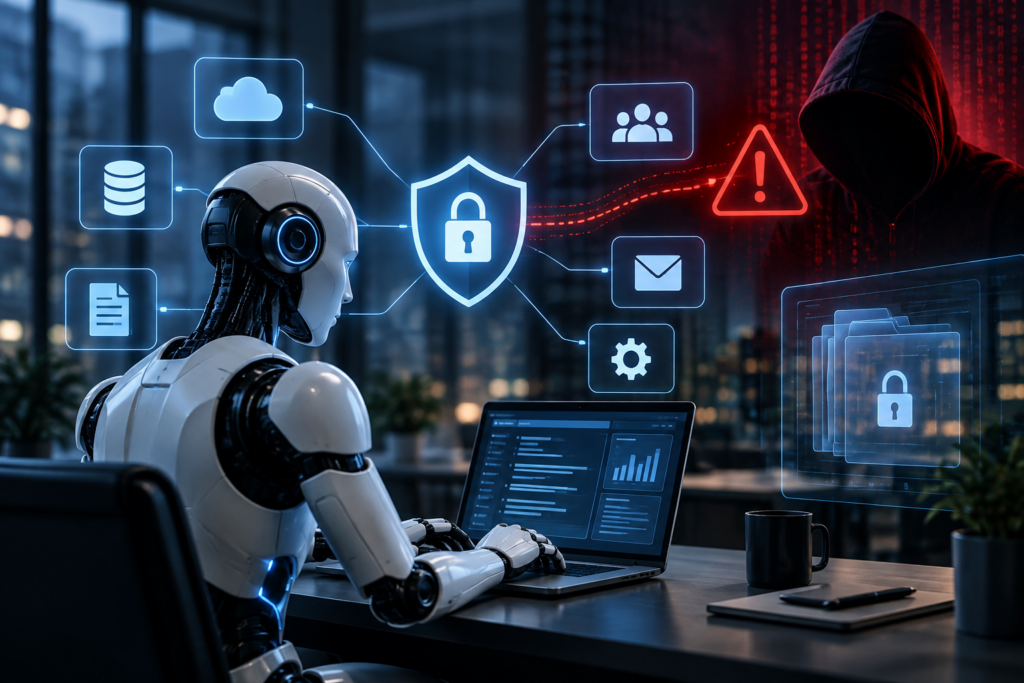
Generated with OpenAI AI
AI agents are quickly becoming part of everyday business software. Unlike traditional chatbots, they can do more than generate answers. An AI agent can fetch business data, call APIs, use software tools, coordinate multi-step workflows, and operate with limited human supervision.
That is what makes agents valuable — and what makes them an increasing security concern.
An agent connected to a public knowledge base may have relatively limited exposure. The consequences can be far greater when an agent is connected to a company’s CRM, cloud storage, internal documents, or production systems and its permissions are misused or its instructions are manipulated.
So, in 2026, enterprise AI security is about more than protecting AI models. Organizations also need to know who an AI agent is, what it can access, what tools it can use, and what actions it can take.
How AI Agents Change the Security Equation
For a long time, enterprise software has been built around predefined rules. AI agents are more flexible because they can interpret information, select tools, and determine the next step in a workflow.
That autonomy creates a different security boundary.
NIST has been examining identity and authorization for software and AI agents, including authentication, authorization, least privilege, delegation, auditing, and non-repudiation. The agency’s work is part of a growing effort to establish appropriate controls when agents interact with enterprise resources.
The problem is not that an AI agent is inherently unsafe. The problem is that an autonomous system can potentially turn its permissions into actions.
For enterprises, traditional access control therefore needs to be considered alongside an agent’s ability to interpret instructions and interact with tools.
The Biggest AI Agent Security Risks
Agent Hijacking and Prompt Injection
Prompt injection continues to be a major security concern for agentic AI.
An attacker can place malicious instructions inside content that an agent is expected to process. Depending on the system design, those instructions can influence the agent’s behavior.
This becomes more serious when the agent can use external tools.
For example, an AI agent might be asked to research information from a website. If that website contains instructions designed to manipulate the agent, the system could encounter content that appears to be ordinary information but is actually an attempt to influence its behavior.
NIST has specifically studied indirect prompt injection and agent hijacking, highlighting the need for controls that address both model behavior and the tools available to agents.
Google Threat Intelligence has also documented the move toward more autonomous AI-assisted workflows in cyberattacks, showing how agentic capabilities can affect both offensive and defensive security operations.
Too Many Permissions
The principle of least privilege is especially important for AI agents.
An agent should have only the permissions required for its assigned task. A customer-support agent might need access to customer records and the ability to create support tickets, but it may not need permission to delete accounts or change administrator settings.
The more systems an agent can access, the greater the potential impact of a compromised credential, malicious instruction, or unexpected model behavior.
NIST’s work on AI agent identity and authorization specifically considers authorization, least privilege, delegation, auditing, and related security controls for autonomous software agents.
The principle is straightforward: an agent should have enough authority to complete its job, but not unnecessary authority that expands the consequences of an error or compromise.
Sensitive Data Exposure
AI agents can be useful precisely because they can combine information across several systems.
An enterprise agent might pull information from a CRM, internal documents, analytics platforms, email, or a database during a single workflow. That raises an important question for security teams: What information can the agent access once those systems are connected?
Data access therefore needs to be considered at the workflow level, not only at the individual application level.
This becomes particularly important as businesses move from simple AI assistants toward more autonomous systems capable of coordinating several tools in one process.
AI Agents Require Clear Digital Identities
One of the biggest changes in enterprise security is the emergence of AI agents as another form of non-human identity.
Companies have managed service accounts, applications, APIs, and automated systems for years. AI agents add another dimension because they can perform increasingly complex tasks on behalf of employees.
Security teams should be able to identify their production agents and answer straightforward questions:
- Who owns the agent?
- What does it do?
- Which systems can it access?
- What permissions does it have?
- Which credentials does it use?
- Who granted those permissions?
- What actions has it taken?
- How quickly can its access be revoked?
NIST’s 2026 work on software and AI agent identity directly addresses challenges around authorization, auditing, delegation, and non-repudiation.
The goal is not to treat AI agents like employees. Instead, organizations need a reliable way to understand and control the authority they give to autonomous software.
Businesses building agents can also benefit from understanding how to build AI agents for startups, particularly when security controls need to be considered alongside deployment and scalability.
MCP Is Adding New Tool-Access Considerations
The increasing adoption of the Model Context Protocol (MCP) has brought even more attention to the security of AI agents.
MCP provides a standardized way for AI applications to interact with external tools and data sources. That makes agents more useful because they can interact with systems outside the model itself.
But every connection creates another security boundary.
In 2026, the NSA published security design considerations for AI-driven automation using MCP. The guidance addresses concerns including dynamic tool invocation, trust boundaries, context sharing, and agent misuse.
The official MCP authorization specification also addresses authorization and security considerations around access and token handling.
For enterprises, attaching an agent to another application should therefore be treated as adding another capability — not simply installing another integration.
How Businesses Can Protect AI Agents
Make Sure Each Agent Has a Distinct Identity
Organizations should maintain an inventory of AI agents operating in production and assign clear ownership to each one.
Security teams should be able to distinguish one agent from another in authentication and activity logs.
Use Least-Privilege Access
Grant agents only the permissions they need.
Where practical, separate read and write permissions and restrict access to the specific systems required for the workflow.
This limits the potential impact if an agent is manipulated or its credentials are compromised.
Watch Agent Activity
Logging should go beyond simply knowing whether an agent is running.
Organizations should monitor tool usage, authentication events, data access, permission changes, and unusual sequences of actions.
This visibility becomes particularly important when an agent interacts with several applications during a single task.
Require Approval for High-Risk Actions
Not every agent action requires human approval.
However, sensitive operations such as deleting records, changing access controls, transferring money, or modifying production infrastructure may require additional authorization.
A practical approach is to allow greater autonomy for routine tasks while applying tighter controls to actions with significant consequences.
Test Against Prompt Injection
AI agents should be tested against realistic attack scenarios, including malicious webpages, documents, emails, customer messages, and other external content they may encounter during normal operation.
Security testing should not only determine whether a model follows instructions correctly. It should also test whether an agent can be manipulated into misusing its connected tools.
For businesses looking at the broader shift in AI security, conventional security measures may not be enough for AI agents, particularly when autonomous systems have access to business-critical resources.
AI Agent Security Is Becoming an Enterprise Discipline
The security discussion around AI agents is moving beyond model-level protection.
NIST launched its AI Agent Standards Initiative in 2026, focused on secure and interoperable agent ecosystems. The initiative is part of a broader effort to address the standards and security challenges emerging as agentic AI becomes more capable.
At the same time, threat-intelligence researchers are documenting how increasingly autonomous AI systems are being incorporated into real-world attack workflows. Google Threat Intelligence’s research on the evolution of adversarial AI describes adversaries moving from basic prompting toward more autonomous AI-assisted operations.
For businesses, the message is straightforward: AI agents should not be treated as ordinary chatbots with a few extra features.
They are software systems that can access resources, interpret information, make decisions, and take actions.
That makes identity, authorization, least privilege, monitoring, tool security, and rapid revocation important components of a responsible AI-agent architecture.
The real security question in 2026 is not whether businesses can use AI agents.
It is whether they can give those agents enough authority to be useful while keeping that authority visible, limited, and controllable.