Share This Article
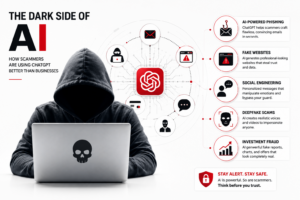
Artificial intelligence has emerged as one of the most transformative technologies of the 21st century. From revolutionizing customer service chatbots to powering predictive analytics in healthcare and finance, AI is reshaping industries at an unprecedented pace. Businesses worldwide are pouring billions into AI infrastructure, with companies like Google, Microsoft, and OpenAI leading the charge. Startups are racing to integrate generative AI into their products, while professionals scramble to upskill in tools like ChatGPT, Claude, and Gemini to boost productivity.
Yet, amid this corporate enthusiasm, a shadowy counterpart has been operating with remarkable agility: cybercriminals and scammers. While legitimate organizations grapple with regulatory hurdles, ethical considerations, and integration challenges, fraudsters have embraced AI tools like ChatGPT with surprising effectiveness. In many cases, they are outpacing businesses in leveraging these technologies for deception, fraud, and large-scale manipulation.
This article explores how scammers are using ChatGPT and related AI tools to supercharge their operations. We’ll examine real-world tactics, the psychological and technical advantages AI provides, why businesses are falling behind, and—most importantly—practical steps for individuals and organizations to defend themselves in this evolving threat landscape. By the end, you’ll understand why awareness of these dark applications is no longer optional but essential for digital safety.
Table of Contents
The AI Revolution Has a Dark Side
Every groundbreaking technology carries dual potential. The printing press democratized knowledge but also spread propaganda. The internet connected billions but birthed cybercrime. Social media fostered communities but amplified division. Artificial intelligence follows this pattern precisely.
ChatGPT, launched by OpenAI in late 2022, quickly became a global phenomenon, reaching 100 million users in just two months. Its ability to generate human-like text, code, and ideas made it invaluable for writers, coders, marketers, and educators. However, the same capabilities that fuel innovation also empower malicious actors.
Scammers no longer need advanced programming skills or teams of copywriters. A single individual with access to a free or low-cost ChatGPT account can now produce sophisticated fraud materials at scale. This democratization of advanced tools has lowered the barrier to entry for cybercrime dramatically, allowing even novice fraudsters to compete with seasoned operators.
The scale is staggering. Cybersecurity firms like SlashNext report a surge in AI-generated phishing attempts, with some estimates suggesting that up to 30-40% of new malicious content incorporates generative AI elements. Discussions around how scammers are using ChatGPT now dominate cybersecurity conferences, threat intelligence reports, and regulatory briefings.
Why AI Is So Attractive to Scammers
Scammers operate on volume and conversion rates. Their success depends on casting wide nets while making each interaction feel personal and trustworthy. Traditional scams were hampered by language barriers, inconsistent quality, and detectable patterns. AI eliminates many of these weaknesses.
Key advantages include:
- Speed and Scale: Generate thousands of unique messages in minutes rather than days.
- Quality: Near-flawless grammar, professional tone, and cultural adaptation.
- Personalization: Incorporate victim-specific details pulled from public data.
- Adaptability: Real-time conversation handling that maintains context.
- Multimodality: Integration with tools for images, voice, and video.
In the past, a Nigerian prince email scam was easy to spot due to broken English and generic pleas. Today, how scammers are using ChatGPT allows them to craft emails that mimic the exact writing style of a target’s colleagues or bank representatives, complete with industry jargon and subtle emotional manipulation.
The Rise of AI-Powered Phishing
Phishing remains the most common entry point for cyberattacks, responsible for over 80% of breaches according to various industry reports. AI has transformed it from a blunt instrument into a precision tool.
A typical AI-enhanced phishing workflow looks like this:
- Scammer gathers basic victim data (name, employer, recent news).
- Prompts ChatGPT: “Write a professional email from [Bank Name] security team about a suspicious login attempt. Reference the user’s recent transaction in [City]. Use urgent but reassuring language.”
- Refines output with follow-up prompts for variations.
- Deploys via compromised accounts or bulk email services.
The results are emails that bypass traditional filters. They feature correct branding, proper formatting, and contextually relevant details. Employees trained to look for typos are now facing messages indistinguishable from legitimate ones.
Advanced variants include “spear-phishing” targeting executives (whaling) and “business email compromise” (BEC) scams, which cost organizations billions annually. In one documented case, fraudsters used AI to impersonate a CEO, convincing a finance officer to transfer $25 million. The email matched the executive’s tone so perfectly that initial investigations struggled to prove it was fake.
Personalized Scams at Scale
Personalization was once a major bottleneck. Gathering and incorporating individual data manually was time-intensive. AI changes the equation entirely.
Scammers now scrape data from LinkedIn, Facebook, Instagram, company press releases, and data brokers. They feed this into AI models to generate hyper-targeted content:
- A marketing professional receives an email referencing their latest campaign and a “partnership opportunity” with a fictional vendor.
- A parent gets a message about their child’s school, complete with the school’s logo (AI-generated) and a urgent tuition payment link.
- An investor sees analysis tailored to their portfolio holdings.
This level of customization dramatically increases success rates. Studies from cybersecurity firms show personalized attacks can be 5-10 times more effective than generic ones.
How scammers are using ChatGPT here extends beyond text. Combined with tools like browser automation scripts, they can run campaigns that adapt dynamically based on victim responses.
Fake Customer Support Is Becoming Smarter
Tech support scams have long preyed on vulnerable users, often involving fake pop-ups claiming viruses or account issues. AI takes this to the next level with conversational agents.
Fraudsters now deploy AI chatbots or voice systems that:
- Respond naturally to questions.
- Remember conversation history.
- Escalate urgency (“Your account will be locked in 5 minutes”).
- Guide victims through “fix” processes that actually install malware or steal credentials.
In voice-based scams, tools like ElevenLabs or similar voice synthesis combined with ChatGPT scripts create phone calls that sound eerily authentic. Victims report speaking with “support agents” who knew details about their recent purchases or device history—information easily pulled from public leaks or social media.
The Explosion of Fake Online Reviews and Content
Consumer trust increasingly rests on reviews. AI allows scammers to flood platforms with fake testimonials:
- Hundreds of 5-star reviews for shady products, each with unique stories (“I was skeptical but after 2 weeks my skin looks amazing!”).
- Negative campaigns against competitors.
- Forum posts and Reddit comments that build narrative credibility.
Platforms like Amazon, Google, and TripAdvisor invest heavily in detection, using their own AI countermeasures. However, the arms race continues, with sophisticated scammers using adversarial techniques to evade filters.
This manipulation distorts markets and erodes consumer confidence, costing legitimate businesses lost sales and reputational damage.
Social Engineering Gets an AI Upgrade
Social engineering exploits human psychology—fear, greed, authority, reciprocity. AI supercharges message crafting:
- Urgency: “Act now before your account is compromised!”
- Authority: Impersonating bosses, government officials, or celebrities.
- Curiosity: “Click here to see what your neighbors are saying about you.”
- Emotional Manipulation: Tailored sob stories or romantic lures.
By iterating prompts (“Make this more empathetic” or “Add subtle urgency without sounding desperate”), scammers optimize for psychological impact.
Deepfakes and Multimodal Threats
While ChatGPT is text-focused, the broader AI ecosystem enables devastating combinations:
- Deepfake videos of executives announcing fake mergers or crises.
- Voice cloning for phone scams (e.g., “This is your grandson; I’ve been arrested and need bail money”).
- AI-generated images of products, documents, or people.
High-profile incidents include fake celebrity endorsements for crypto scams and synthetic media used in political disinformation.
AI-Powered Investment and Romance Scams
Investment fraud has gone high-tech. Fraudsters create entire fake ecosystems:
- Professional websites with AI-generated market reports.
- Chatbots providing “personalized” investment advice.
- Deepfake testimonials from “satisfied clients.”
Romance scams similarly benefit, with AI maintaining long-term conversations across multiple victims, crafting believable backstories, and escalating to financial requests.
Why Businesses Are Falling Behind
This is perhaps the most ironic aspect of how scammers are using ChatGPT more effectively.
Barriers for legitimate organizations:
- Compliance and Regulation: GDPR, CCPA, and emerging AI laws require impact assessments, bias testing, and transparency.
- Internal Processes: Procurement, legal review, IT security approvals slow adoption.
- Risk Aversion: Fear of data leaks, hallucinations, or brand damage.
- Resource Allocation: Focus on productivity tools rather than defensive innovation.
Scammers face zero bureaucracy. They operate in jurisdictions with weak enforcement, use stolen credentials, and prioritize speed over ethics. This asymmetry allows rapid experimentation and deployment.
The Human Factor: The Eternal Vulnerability
Technology evolves, but human psychology remains relatively constant. AI doesn’t replace the need for social engineering—it amplifies it. Even the best AI defenses fail if employees or users make poor decisions under pressure.
Common psychological triggers exploited:
- Fear of Loss: “Your funds are at risk.”
- Greed: “Double your investment in 30 days.”
- Authority Bias: Impersonating trusted figures.
- Social Proof: Fake reviews and testimonials.
How Individuals Can Protect Themselves
- Verify Independently: Never use contact info from unsolicited messages. Call official numbers or log in directly to accounts.
- Pause and Reflect: Urgency is a red flag. Take time to verify.
- Check Links and Attachments: Hover over links. Use URL scanners.
- Enable Multi-Factor Authentication (MFA): Especially app-based or hardware keys.
- Stay Educated: Follow reliable sources like Krebs on Security, FTC scam alerts, or CISA.
- Use AI Defensively: Tools like email scanners or ChatGPT itself to analyze suspicious messages (“Is this email likely a scam? Explain why.”).
- Limit Personal Data Exposure: Review privacy settings on social media.
How Businesses Can Respond
- Comprehensive Training: Regular simulations of AI-enhanced attacks.
- Zero-Trust Verification: Require secondary confirmation for financial or data requests.
- AI-Powered Defenses: Deploy tools that detect anomalous language patterns or deepfakes.
- Incident Response Plans: Specific protocols for AI-driven threats.
- Collaboration: Share intelligence with industry groups and law enforcement.
- Ethical AI Adoption: Accelerate responsible internal use to close the innovation gap.
The Future of AI-Powered Fraud
Looking ahead, we can expect:
- Autonomous AI agents running entire scam campaigns.
- Real-time multimodal interactions (voice + video + text).
- Integration with ransomware and data exfiltration.
- Targeted attacks on AI systems themselves (prompt injection, model poisoning).
Regulatory responses are emerging—EU AI Act, U.S. executive orders—but enforcement lags behind technology.
Conclusion
The story of AI is one of immense potential for good, but ignoring its dark side would be naive. How scammers are using ChatGPT highlights a critical truth: powerful tools are morally neutral. Their impact depends entirely on the hands that wield them.
Businesses must move faster—not just in adoption, but in building resilient cultures of security awareness. Individuals need to cultivate healthy skepticism in an era where seeing (or reading) is no longer believing.
By shining a light on these tactics, we empower ourselves to counter them. Vigilance, education, and proactive defense will determine whether AI’s dark side remains a manageable risk or becomes an overwhelming threat.
The future belongs not just to those who develop AI, but to those who use it wisely—and defend against its misuse effectively.