Share This Article
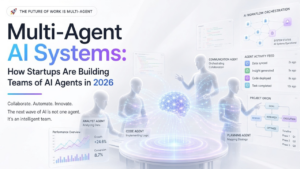
In 2026, the conversation around artificial intelligence has shifted dramatically. Single autonomous agents that handle isolated tasks are no longer enough for ambitious startups. The real competitive edge now comes from coordinated groups of specialized agents that plan, collaborate, and execute complex workflows together. These Multi-Agent AI Systems are transforming how early-stage companies operate, allowing small teams to achieve output that previously required much larger headcounts.
This article explores exactly how startups are designing, deploying, and scaling Multi-Agent AI Systems in 2026. We will cover the architecture patterns that work, the practical use cases delivering measurable ROI, the tools powering these systems, the challenges founders must navigate, and the steps any startup can take to start building their own agent teams today.
Table of Contents
Understanding Multi-Agent AI Systems in the Current Landscape
At their core, Multi-Agent AI Systems consist of multiple specialized AI agents that communicate, share context, and divide responsibilities to achieve a shared goal. Unlike a single large language model prompted to do everything, each agent in these systems has a defined role, access to specific tools, and the ability to hand off work or request help from peers.
In practice, one agent might act as a planner that breaks down a high-level objective into sub-tasks. Another agent specializes in research and data retrieval. A third handles code generation or document drafting. A fourth monitors progress and intervenes when something goes wrong. A fifth manages external communications or CRM updates. Together they form a digital workforce that operates with far greater reliability and depth than any individual agent could achieve alone.
This architecture mirrors how effective human teams function. Clear specialization reduces errors. Communication protocols keep everyone aligned. Hierarchical or peer-to-peer coordination ensures accountability. In 2026, the maturity of foundation models, tool-calling capabilities, long-context windows, and orchestration frameworks has finally made reliable Multi-Agent AI Systems practical for resource-constrained startups rather than just large research labs.
Why 2026 Is the Breakout Year for Multi-Agent AI Systems
Several converging factors have made 2026 the inflection point. Foundation models have improved dramatically in reasoning, tool use, and multi-step planning. Context windows routinely exceed one million tokens, allowing agents to maintain shared memory across long workflows. Orchestration platforms have matured, offering visual builders, robust state management, and built-in evaluation tools. At the same time, the cost of inference has dropped enough that running several agents in parallel is no longer prohibitively expensive for early-stage companies.
Enterprise demand has also accelerated adoption. Companies that experimented with single agents in 2024 and 2025 quickly discovered the limitations of siloed automation. Customer support agents that could not escalate complex issues, sales agents that could not coordinate with product or finance, and research agents that could not verify findings against multiple sources all created friction. Multi-Agent AI Systems solved these coordination problems and delivered higher completion rates on real business processes.
Startups have been especially quick to adopt because they face intense pressure to do more with less. A five-person founding team can now deploy a coordinated agent team that handles lead research, outreach, meeting scheduling, follow-up sequences, CRM hygiene, and basic support triage. The productivity multiplier is significant, and the capital efficiency gains are even larger because headcount can be delayed while output continues to grow.
Core Architecture Patterns Startups Are Using
Successful Multi-Agent AI Systems in 2026 generally follow a few proven patterns. The most common is the hierarchical planner-executor model. A high-level planner agent receives the overall goal, decomposes it into ordered subtasks, and assigns those subtasks to specialist executor agents. The planner monitors progress, re-plans when obstacles appear, and consolidates final results.
A second popular pattern is the peer-to-peer collaborative model. Agents of roughly equal capability negotiate task ownership, share intermediate results, and critique each other’s work. This approach works well for creative or exploratory workflows such as product research, competitive analysis, or content ideation.
A third pattern combines both approaches with a supervisor or critic agent that sits above the working group. The supervisor does not execute tasks itself but reviews outputs for quality, consistency with company policy, and risk. Many startups running customer-facing agents use this pattern to maintain brand voice and compliance.
Shared memory is another critical design decision. Early multi-agent experiments suffered from agents that lost context or contradicted one another. In 2026, most production systems use a combination of short-term conversation memory, a structured vector store for long-term knowledge, and a shared state object that tracks task status, decisions made, and open questions. This shared state acts as the single source of truth for the entire agent team.
Tool access is carefully scoped. Each agent receives only the tools required for its role. A research agent might have web search, internal knowledge base retrieval, and document parsing. A coding agent receives repository access, test runners, and deployment tools. An operations agent gets calendar, email, and CRM permissions. Restricting tools dramatically reduces the chance of unintended actions and makes auditing easier.
High-Impact Use Cases Delivering Results for Startups
Startups across industries are already extracting real value from Multi-Agent AI Systems. One of the strongest use cases is end-to-end sales development. A research agent identifies and qualifies leads. A personalization agent crafts tailored outreach based on recent company news and LinkedIn activity. An outreach agent manages multi-channel sequences. A scheduling agent handles calendar coordination. A CRM agent keeps records clean and triggers next steps. Human salespeople only enter the conversation when a prospect is ready for a high-value discussion. Several seed and Series A companies report that this setup has allowed them to maintain outbound volume with one or two people that previously required a full SDR team.
Customer support is another area of rapid adoption. Tier-1 resolution agents handle routine queries by pulling account data and knowledge base content. Escalation agents detect frustration or complexity and route to the right human specialist with full context already prepared. Quality agents review resolved tickets and surface patterns that should be fed back into the knowledge base. The result is faster response times, higher customer satisfaction scores, and lower support headcount relative to ticket volume.
Product and engineering teams use Multi-Agent AI Systems for continuous discovery and prioritization. Research agents monitor user feedback channels, support tickets, and competitor releases. Synthesis agents cluster insights and propose opportunity areas. Spec agents turn prioritized opportunities into detailed product requirements. Engineering agents can even draft initial technical designs or boilerplate code. The human product manager focuses on strategic judgment rather than information gathering and documentation.
Operations and finance teams deploy agent teams for recurring processes such as invoice chasing, expense categorization, weekly metric compilation, and board report preparation. What used to consume hours of founder or ops time each week now runs largely autonomously, with humans reviewing exceptions and final outputs.
Tools and Platforms Powering Multi-Agent AI Systems in 2026
The tooling landscape has matured significantly. Startups can now choose between low-code orchestration platforms that allow non-engineers to assemble agent teams and more flexible frameworks preferred by technical founders.
Popular low-code and no-code options provide visual canvases for defining agent roles, communication flows, and tool connections. These platforms handle state management, retry logic, and basic evaluation out of the box. They are ideal for operational workflows where speed of iteration matters more than deep customization.
For teams that need tighter control, open frameworks built on top of major foundation models offer full programmability. Developers define agents as code, implement custom communication protocols, and integrate proprietary tools. Many startups begin with a low-code platform for their first production system and later migrate complex workflows to code as requirements grow.
Evaluation and observability have become non-negotiable. Production Multi-Agent AI Systems generate large volumes of intermediate decisions and tool calls. Startups that succeed invest early in logging, tracing, and automated evaluation pipelines that measure task completion rates, hallucination frequency, policy violations, and cost per successful workflow. Without these feedback loops, agent teams drift and quality degrades over time.
Challenges Startups Encounter and How They Overcome Them
Building reliable Multi-Agent AI Systems is not without friction. Coordination overhead can increase latency and cost if agents spend too much time communicating instead of working. Startups mitigate this by designing clear interfaces between agents and minimizing unnecessary back-and-forth.
Error propagation is another risk. A mistake by an early agent can cascade through the entire team. Robust systems include validation steps, confidence scoring, and the ability for later agents to reject or request clarification on flawed inputs.
Security and permission management require careful design. Giving agents access to email, CRM, code repositories, or payment systems introduces real risk. Leading startups apply the principle of least privilege rigorously, require human approval for high-stakes actions, and maintain detailed audit logs of every tool call.
Organizational change management is often underestimated. Employees may feel threatened by agent teams that automate parts of their work. Successful founders position Multi-Agent AI Systems as force multipliers that remove tedious work so humans can focus on higher-judgment activities. They involve team members in designing agent roles and review processes so the systems feel collaborative rather than imposed.
Cost control remains important even as inference prices fall. Running multiple agents in parallel on long workflows can still generate significant bills. Startups that manage this well set budget alerts, use cheaper models for routine subtasks, cache common intermediate results, and continuously prune underperforming agent paths.
A Practical Roadmap for Startups Starting Today
Founders who want to begin with Multi-Agent AI Systems should start narrow. Choose one high-friction, repetitive workflow that currently consumes meaningful human time and has clear success criteria. Map the exact steps a competent human follows. Identify natural points of specialization. Design two or three agents that can cover the core sequence. Implement strong shared memory and clear handoff protocols. Run the system in shadow mode alongside humans for several weeks, measuring accuracy, latency, and cost. Only after the first workflow is reliable should the team expand the agent roster or tackle additional processes.
Governance should be established from day one. Define which actions require human approval. Create review cadences for agent performance. Document decision boundaries so the system stays aligned with company values and risk tolerance as it grows.
Talent strategy also evolves. Startups that scale Multi-Agent AI Systems successfully often hire or upskill people who understand both domain workflows and agent orchestration. These hybrid roles become extremely valuable because they can continuously refine the digital workforce.
Looking Ahead: The Competitive Implications
By the end of 2026 and into 2027, the gap between startups that master Multi-Agent AI Systems and those still relying on single agents or traditional software will widen. The former will operate with higher leverage, faster iteration cycles, and lower fixed costs. They will be able to explore more ideas, serve more customers, and adapt more quickly to market changes.
The technology itself will continue to improve. Better long-term memory, more reliable multi-agent communication protocols, stronger evaluation methods, and tighter integration with enterprise systems will make these systems even more capable. Startups that build institutional knowledge around designing and governing agent teams will compound their advantage over time.
Conclusion
Multi-Agent AI Systems represent one of the most practical and high-leverage applications of artificial intelligence available to startups in 2026. By moving beyond isolated agents and embracing coordinated digital teams, founders can unlock productivity gains that were previously impossible at early stages. The companies that treat these systems as core infrastructure rather than experimental side projects will set a new standard for capital-efficient growth.
The building blocks are ready. The use cases are proven. The competitive window is open. The startups that move deliberately now will define what operational excellence looks like in the agentic era.