Share This Article
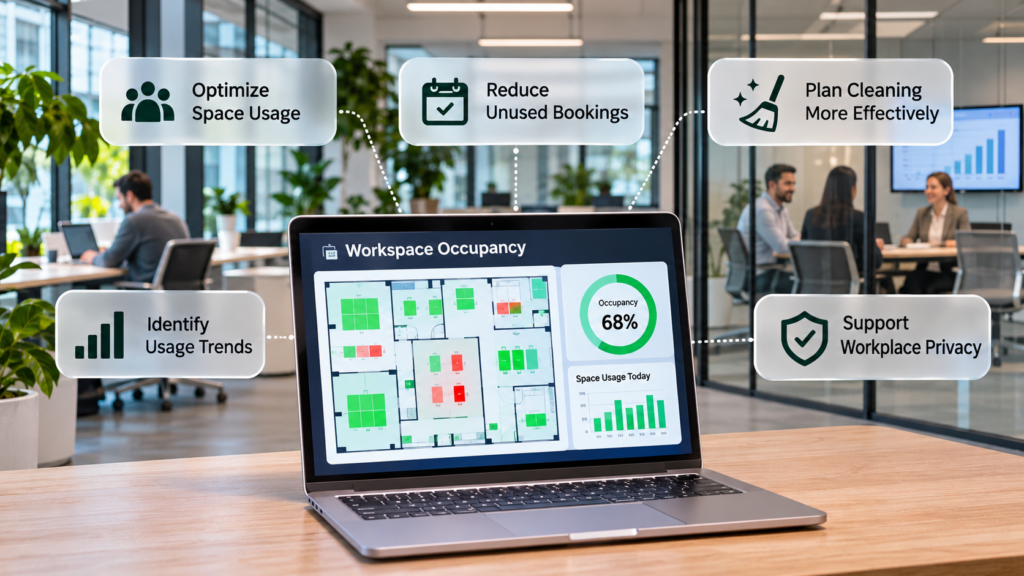
A busy office does not always use its available space efficiently. Employees may struggle to find meeting rooms while reserved rooms remain empty, or arrive at work to discover that their preferred areas are already crowded. These problems have become increasingly relevant as businesses adopt hybrid working arrangements and flexible office environments.
Understanding how employees use desks, meeting rooms and shared facilities can help organizations make better workplace decisions. Instead of relying entirely on booking records or assumptions, businesses can use occupancy information to identify usage patterns and adjust their facilities accordingly.
This is where occupancy tracking solutions become valuable. They help workplace teams understand how spaces are being used throughout the day, identify underutilized areas and improve everyday office operations.
Table of Contents
Measure Actual Workspace Usage Against Bookings
A room reservation records an intention to use a space, but it does not necessarily confirm that the meeting takes place.
For example, an employee might reserve a conference room for an hour but cancel the meeting without releasing the booking. Another team may arrive looking for an available room and find that several spaces appear occupied in the booking system.
Occupancy tracking solutions help workplace managers compare reservation records with actual room activity. This makes it easier to identify frequently unused bookings, recurring scheduling problems and rooms experiencing consistently high demand.
Microsoft’s documentation on room analytics explains how organizations can use room-related data to understand meeting space utilization and booking behavior.
However, businesses should understand what their tracking systems actually measure. Some systems monitor an entire room, while others collect information about specific areas or workstations. Sensor coverage and update frequency can also influence the accuracy of reported activity.
Match Meeting Rooms to Employee Requirements
Not every meeting requires the same amount of space. A team of three employees may regularly occupy a conference room designed for twelve people, leaving fewer suitable options for larger meetings.
Occupancy patterns can help organizations identify these mismatches and understand whether existing room allocations reflect actual demand.
For instance, if small groups frequently use larger conference rooms, management can investigate whether smaller meeting spaces are available or whether employees prefer larger rooms because they offer better equipment.
The solution does not always require changing the office layout. Relocating presentation equipment, improving room descriptions or introducing clearer booking guidelines may address the underlying problem.
Organizations can also introduce check-in policies for meeting rooms. Under these arrangements, reservations may be released automatically when employees fail to confirm their arrival within a defined period.
Find Available Workspace During Busy Periods
Finding an available desk can become frustrating in offices where employees follow different schedules throughout the week.
This is particularly relevant to hybrid workplaces, where attendance patterns may vary between departments and individual employees.
Occupancy information can help employees identify areas with available capacity before walking across the office. Workplace displays, digital floor plans and desk availability dashboards can provide a clearer picture of current workspace conditions.
Businesses exploring flexible workspace arrangements can also learn about hybrid hot desk booking software and how desk booking systems support changing workplace requirements.
However, availability information should be treated as an estimate rather than a guarantee. A floor-level occupancy count may indicate that an area has available capacity without confirming whether a particular desk has the equipment or accessibility features an employee requires.
Organizations can make these systems more useful by combining occupancy information with accurate floor maps, desk descriptions and facility information.
Schedule Cleaning Around Actual Workspace Usage
Traditional cleaning schedules often follow fixed time slots regardless of how frequently different areas are used.
While this approach provides consistency, it may not always reflect the actual requirements of a busy office.
Occupancy patterns give facilities teams additional information about which areas receive frequent use and where cleaning or maintenance attention may be needed.
For example, a shared meeting room used repeatedly throughout the day may require more frequent cleaning checks than a conference room that remains empty for most of the week.
Facilities teams can combine usage information with service logs and employee requests to identify recurring problems and adjust schedules accordingly.
Use Historical Trends to Improve Office Layouts
Daily occupancy readings provide useful information, but individual observations rarely tell the complete story.
A conference room being crowded on one afternoon does not necessarily indicate that an organization needs another large meeting space. Similarly, an empty office area during a holiday week should not immediately trigger a decision to reduce available desks.
Workplace teams should examine usage patterns across comparable working days and consider factors such as employee attendance schedules, company events, seasonal demand and temporary office closures.
CBRE’s research on workplace and occupancy management technology discusses how workplace technology can help organizations understand space utilization and improve planning decisions.
For example, if a collaboration area consistently experiences high demand, management could test a revised layout with additional shared tables nearby.
After introducing the change, the organization can compare occupancy patterns with earlier periods and collect employee feedback to determine whether the adjustment has improved workspace availability.
Establish Clear Privacy and Data Collection Policies
Collecting workplace occupancy information also introduces important privacy considerations.
Organizations should understand what their tracking systems record and ensure that the information collected is appropriate for the operational purpose.
For example, a facilities team trying to determine whether an office needs additional desks generally requires information about workspace usage patterns. It does not necessarily need a detailed record of every employee’s movements throughout the building.
Before deploying occupancy tracking technology, organizations should evaluate:
- What information the system collects.
- Whether it identifies individuals or reports aggregate occupancy.
- Who can access the collected information.
- How long records are retained.
- Whether employees understand the purpose of data collection.
Aggregate reporting can reduce unnecessary exposure of individual information, but it does not automatically make every dataset anonymous. Small work areas with very few occupants may still create identification risks.
Businesses should establish clear data access policies, communicate their monitoring practices and periodically review whether the information being collected remains necessary.
What Should Businesses Consider Before Implementing Occupancy Tracking?
Choosing an occupancy tracking system requires more than comparing available sensors or software features.
Organizations should first identify the workplace problems they want to address. A company struggling with meeting room availability may need different capabilities from one trying to improve desk allocation or facilities management.
Several considerations can help businesses make a more informed decision.
Define the primary objective: Identify whether the main requirement involves meeting room management, desk availability, space planning or facilities operations.
Evaluate data accuracy: Understand how the system detects occupancy, how frequently information updates and what limitations may affect its readings.
Consider integration capabilities: Check whether the solution can work with existing room booking platforms, workplace management software and building systems.
Review privacy requirements: Examine data collection practices, access controls and retention policies before implementation.
Start with a pilot: Testing the solution in selected office areas can help organizations understand its effectiveness before expanding deployment.
Businesses can also explore how to run a small business remotely to understand the broader role of digital tools in managing distributed teams and workplace operations.
Conclusion
Improving daily workspace usage requires a clear understanding of how employees interact with office environments.
Occupancy tracking solutions give organizations another way to identify underused meeting rooms, crowded work areas and changing demand patterns. When combined with booking records, historical trends and employee feedback, this information can support better space allocation and more informed facilities management decisions.
The most practical approach is to begin with a specific workplace problem, establish a baseline and test whether occupancy information can help address it.
Organizations should also consider measurement limitations and employee privacy throughout the process. Ultimately, the objective is not simply to collect more workplace data but to use relevant information to create office environments that are easier to navigate, manage and work in.