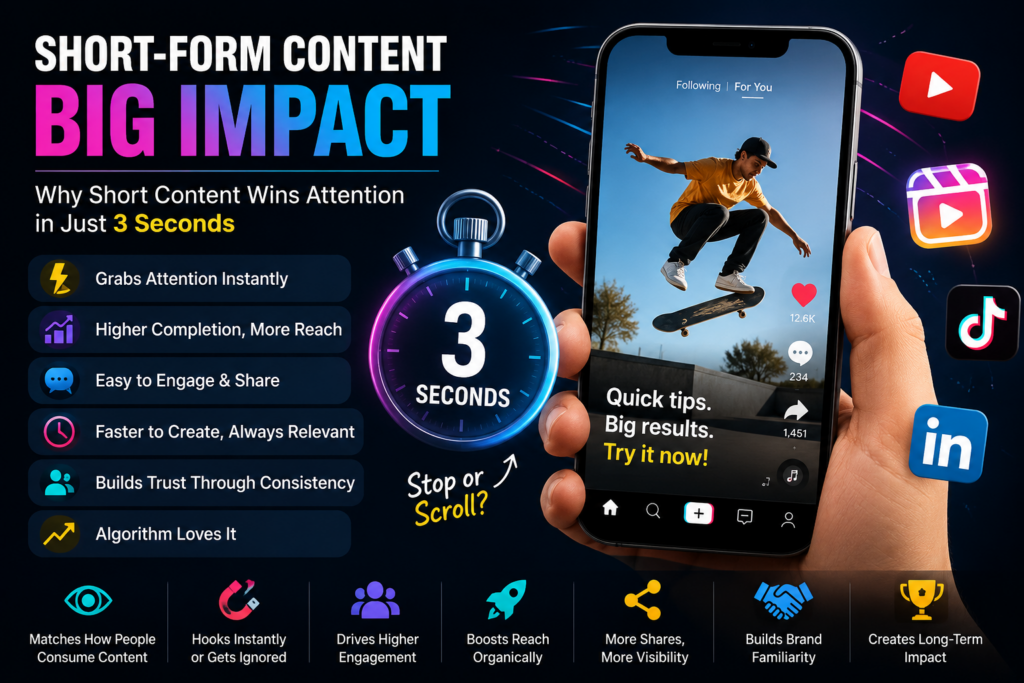
Three seconds. That’s how long someone gives your content before their thumb decides whether to stop or keep scrolling. Not three minutes. Not thirty seconds. Three. And in that window, something either grabs them or it doesn’t. The brands winning attention right now aren’t the ones producing the longest, most detailed content. They’re the ones who figured out how to say something worth stopping for in the time it takes to read a sentence.
The shift happened fast. Five years ago, long-form blog posts and twenty-minute YouTube videos dominated the strategy conversation. Now a fifteen-second Reel outperforms a polished ten-minute explainer because the audience moved and the content had to follow. Understanding the benefits of short-form content is the starting point. Knowing how to use it to drive real engagement is where most brands get stuck. Here are a few ways it actually works.
Table of Contents
1. It Matches How People Actually Consume Content Now
Nobody planned to have a short attention span. The platforms trained it. Infinite scroll, autoplay, and algorithmic feeds. The brain adapted to a content environment that delivers a new stimulus every few seconds. Short-form content doesn’t fight that behavior. It works with it. You meet the audience in the format their brain is already wired to engage with instead of asking them to shift into a mode they’ve been conditioned out of.
2. The Hook Has To Work Instantly, Or It Doesn’t Work At All
Long form gives you time to build to a point. Short form doesn’t. The first frame, the first sentence, and the first two seconds carry the entire weight of whether someone stays or leaves. That constraint forces brands to sharpen their messaging in a way that improves all their content, not just the short stuff. Learning to hook in two seconds makes your ten-minute video better too.
3. Completion Rates Are Dramatically Higher
A sixty-second video gets watched to the end far more often than a five-minute one. Platforms reward completion. When someone watches your entire clip, the algorithm reads that as a quality signal and pushes it to more people. Higher completion rates mean broader distribution without spending a dollar on promotion. The content’s performance markets itself.
4. It Lowers The Barrier To Engagement
Liking a fifteen-second clip feels effortless. Commenting on a quick take feels spontaneous. Sharing a thirty-second video to a friend takes no deliberation. Long content asks for a time commitment before someone can even form an opinion. Short content lets people engage, react, and share right after they consume it. Less friction means more interaction.
5. Production Speed Lets You Stay Culturally Relevant
A trending topic has a 48-hour shelf life. By the time you’ve scripted, filmed, edited, and approved a five-minute response, the moment has passed. Short-form content can go from idea to published in hours. That speed lets brands participate in cultural conversations while they’re still happening instead of showing up three days late with a polished piece nobody cares about anymore.
6. It Trains The Algorithm To Favor Your Account
Every platform, TikTok, Instagram, YouTube Shorts, LinkedIn, rewards accounts that post consistently and generate engagement. Short-form content lets you post more frequently without burning out your production team. Three short clips per week is sustainable. Three long-form videos per week isn’t. Volume plus engagement equals algorithmic momentum that compounds over time.
7. Shareability Is Built Into The Format
People share things that are quick to consume and easy to understand. A sixty-second clip explaining something useful, funny, or surprising gets texted to friends, posted to stories, and dropped in group chats. Long content gets bookmarked with good intentions and forgotten. Short content moves between people in real time because forwarding it costs the sender nothing.
8. It Builds Familiarity Through Repetition
One long video might make an impression. Fifteen short clips over three weeks make a brand feel like a familiar presence. Repetition builds recognition, and recognition builds trust. Short-form content lets you stay visible in someone’s feed consistently without asking them to commit twenty minutes every time they encounter you.
9. Platform Features Actively Prioritize It
Instagram pushes Reels. YouTube promotes Shorts. TikTok built an empire on it. LinkedIn’s algorithm favors video and carousel posts over long articles. The platforms themselves have decided that short-form content gets preferential treatment in their distribution engines. Working with that priority instead of against it means more reach for less effort.
Attention Is The Currency. Short Form Is How You Earn It.
Every brand is competing for the same finite resource: someone’s attention during a scroll session. The brands earning that attention consistently aren’t doing it with longer, more detailed, more expensive content. They’re doing it by saying something worth stopping for in a format that respects how people actually consume information today. Short-form content isn’t the future of marketing. It’s the present. And the gap between brands that recognized that and brands that didn’t is already visible in the numbers.