Share This Article
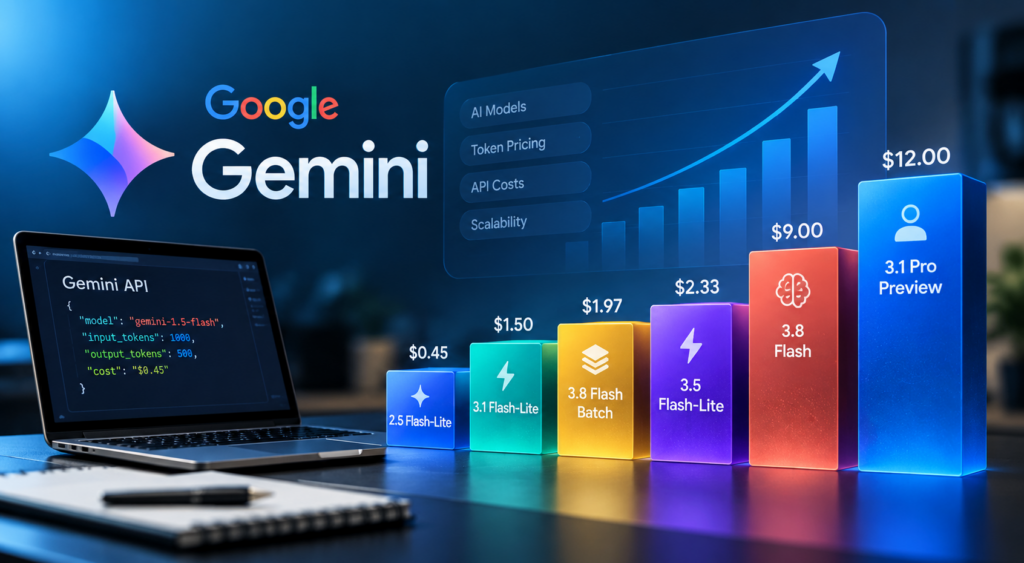
On the first day of 2027, Gemini 3.8 Flash’s introductory price ends and the Standard rate doubles. Google’s pricing page lists $0.75 per million input tokens through December 31, 2026, then $1.50; output goes from $3.75 to $7.50. The same introductory window applies to Gemini 3.7 and 3.6 Flash. Google’s Gemini API pricing page is the reference to use because the rates are explicitly tied to their dates and service tiers.
Hold onto that. A price carries a tier and a date; a budget without either is a guess.
Table of Contents
What you are paying for
Every price here is Google’s list price as checked in October 2026, in US dollars per million tokens. The page changes often; check it before you budget.
Three things move a Gemini bill.
Input tokens are what you send. Output tokens are what comes back, and Google labels that column “Output price (including thinking tokens).” Thinking is billed as output, and on the models covered here output costs several times input.
The third mover is prompt length. On Google’s 2026 list, Gemini 3.1 Pro Preview, Standard tier, charges $2.00 input and $12.00 output for prompts up to 200,000 tokens, then $4.00 and $18.00 above that. Cross that threshold and both rates move to the higher band.
Now the calculators. Third-party pricing pages can mix Google’s Standard, Batch, and other service tiers, so compare their numbers with the official Gemini API pricing table before using them in a budget. For example, the official Batch rate for Gemini 3.8 Flash is $0.375 input and $1.875 output through December 31, 2026—half the Standard rate.
Where to run your first prompts
Rank these by what each asks before the first answer.
- ai. Its page of free AI tools collects tools that can be used without an account or API key. It can be useful for trying prompts before committing to an API billing setup.
- Google AI Studio. Google says AI Studio usage is free of charge in all available regions, and it lets you work with Gemini models through a Google account. The moment your question becomes “how does Gemini itself answer this,” AI Studio is the more relevant test environment.
- The Gemini API free tier. Google says new accounts begin on the Free Tier, which gives access to certain models up to their model-specific free-tier limits. Google’s billing documentation also notes that Free Tier prompts and responses may be used to improve Google products, whereas paid services have different data-use terms. Rate limits and quotas vary by model and can be viewed in AI Studio.
- The paid tier, the floor: Google says upgrading to the Paid Tier requires linking billing and prepaying a minimum of $5. Purchased credits expire after one year. That is credit, not a setup fee.
The study bot, worked on the board
A study bot: 50 requests a day for 30 days, so 1,500 a month. Each sends 1,000 input tokens and gets 500 back, so 1,500,000 input and 750,000 output tokens a month. Prices are per million, so the bill is 1.5 times input price plus 0.75 times output price. Standard tier unless marked. Sums that run past the cent are rounded to the nearest cent.
Gemini 2.5 Flash-Lite: 1.5 × 0.10 + 0.75 × 0.40 = $0.45.
Gemini 3.8 Flash on Batch, through the end of 2026: 1.5 × 0.375 + 0.75 × 1.875 = $1.97. On Standard through the last day of 2026: 1.5 × 0.75 + 0.75 × 3.75 = $3.94. On Standard from the first day of 2027: 1.5 × 1.50 + 0.75 × 7.50 = $7.88. Gemini 3.5 Flash: $9.00. Gemini 3.1 Pro Preview, prompts under the 200,000-token break: $12.00.
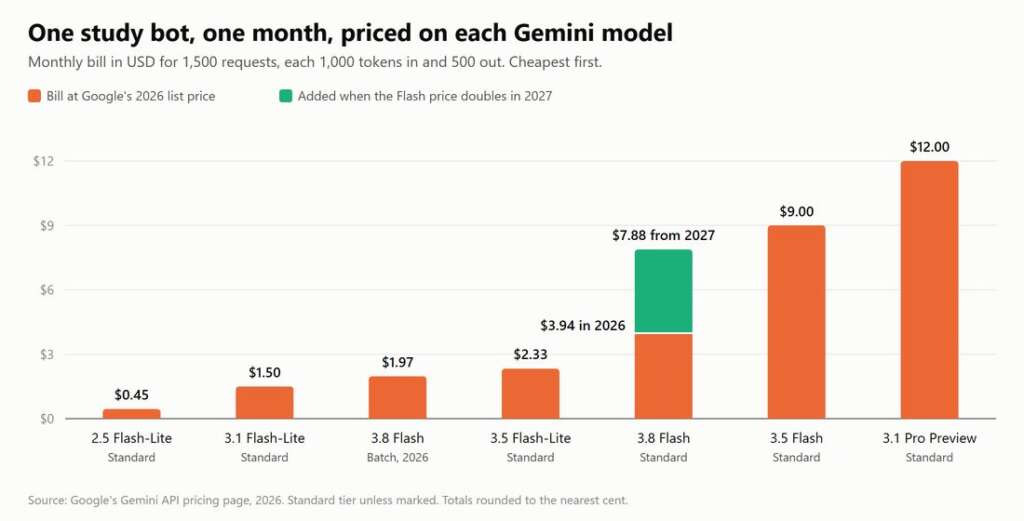
The same month priced model by model. Gemini 3.8 Flash Standard rises from $3.94 in 2026 to $7.88 from 2027; Gemini 3.5 Flash is $9.00 and Gemini 3.1 Pro Preview is $12.00.
Three lessons on the board. On 3.8 Flash at 2026 Standard prices, output was 33.3% of the tokens but 71.4% of the bill: a shorter answer saves more than a shorter question. The identical month costs 26.67 times as much on 3.1 Pro Preview as on 2.5 Flash-Lite. And $5 of credit covers 1.27 months of this bot on 3.8 Flash at 2026 Standard prices.
The long-prompt trap
One request on Gemini 3.1 Pro Preview, Standard tier. Paste 190,000 tokens and get 2,000 back: 0.19 × 2.00 + 0.002 × 12.00 = $0.404.
Paste 250,000 tokens, same 2,000 back: 0.25 × 4.00 + 0.002 × 18.00 = $1.036.
The prompt grew 1.32 times. The cost grew 2.56 times, because crossing 200,000 tokens switched both rates, output included. Split long documents so each prompt stays under the break when that makes sense for the task.
The free tier in Google’s exact words
Google’s current billing documentation says new accounts begin on the Free Tier and that Free Tier access is limited to certain models and their model-specific rate limits. It also states that, on the Free Tier, prompts and responses may be used to improve Google products. Google’s billing documentation is the appropriate reference rather than reproducing a pricing-card quote that can change.
Google’s rate-limit documentation explains requests per minute, tokens per minute, and requests per day, while account-specific quota and limits can be viewed in AI Studio. View Gemini API rate limits.
Rewind.ai separately states that anonymous users receive 2,500 tokens per day and that its free models are not Gemini. Those tokens are Rewind’s own allowance, so never set that figure beside a Gemini per-million price.
Redo the sum with the date on it
Try it with your own numbers: requests a day, times 30, times tokens each way, each price tagged with its tier and end date. For the study bot on Gemini 3.8 Flash, Standard tier, the board reads:
$3.94 a month through the last day of 2026, $7.88 a month from the first day of 2027.
The figures above use Google’s published Standard and Batch token rates and exclude taxes, extra tool charges, grounding, and any workload-specific changes in token consumption.