Share This Article
AI-generated image
The first wave of healthcare technology mostly focused on moving paper off the desk and onto a screen. Charts became electronic records, fax machines gave way to patient portals, and billing moved into software, but much of the work itself stayed just as heavy as ever.
The next wave looks different because the newest tools take work away rather than shift it somewhere else. These tools are showing up in the parts of the day that doctors complain about most, such as writing notes, answering messages, and dealing with insurers.
Not all of it will live up to the sales pitch, but enough of it already works that practices need a clear way to separate useful tools from the noise.
Table of Contents
From Digital Paper to Tools That Do Some of the Work
For about fifteen years, most health software asked doctors to do more typing in return for better records. The trade made sense on paper, but in practice it pushed much of the workday into the evening, with charts finished long after the last patient left.
The shift now is toward tools that take on part of the job themselves. Instead of handing a doctor a blank template, newer systems draft the note, sort the inbox, or fill in the insurance form, then hand it over for checking and signing. The doctor still makes every decision, but the first draft no longer has to start from nothing.
Everything Runs Through the Record
This is possible because newer tools increasingly live inside the record system rather than alongside it. Today’s certified EHR software functions less like a filing cabinet and more like a central hub, bringing notes, scheduling, messaging, billing, and records from other organizations into the same workflow. When a tool is built into that hub, it opens with the patient’s history, reason for the visit, and insurance details already in context, eliminating the need for staff to re-enter information.
That integration is often more important than the tool’s feature list. A product that requires a separate window, login, and data copy may generate enthusiasm at first but quickly fall out of use. By contrast, a tool that appears naturally within the workflow staff already follow is far more likely to become part of the routine.
Ambient Documentation Is the Clearest Early Win
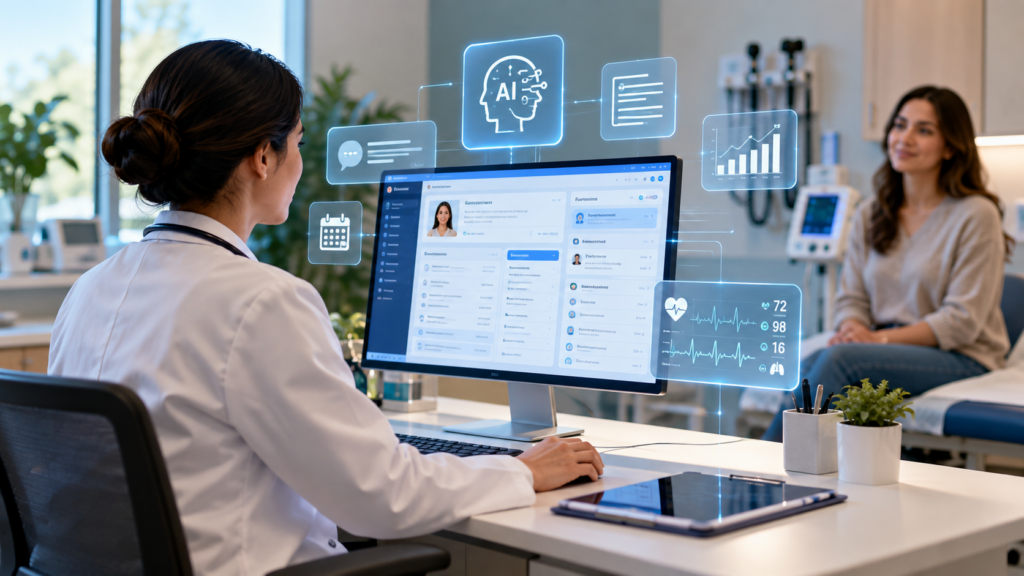
The most talked-about change is the ambient scribe, which listens to the conversation during a visit, with the patient’s permission, and turns it into a draft note. The doctor reads the draft, makes any necessary corrections, and signs it, instead of typing the entire note from memory at the end of the day.
Early evidence is encouraging, and the largest look so far comes from a multicenter study published in JAMA Network Open in 2025 that followed clinicians across six health systems and found that the share reporting burnout dropped from about 52 percent to about 39 percent within 30 days of starting to use ambient scribes. The same clinicians reported spending less time on after-hours notes and paying closer attention during visits.
The results are not magic, though, and a randomized trial at UCLA found smaller time savings while noting that the drafts sometimes contained clinically important errors, most of them details that had been left out. These tools save the most time when you treat the draft as a draft and read it properly before you sign it.
Prior Authorization Is Finally Getting Faster
Getting approval from an insurer before treatment has long been one of the most frustrating parts of running a practice, and it is one area where the rules and technology are finally moving in the same direction. Under the CMS Interoperability and Prior Authorization Final Rule, Medicare Advantage, Medicaid, and CHIP plans have had to answer standard requests within seven calendar days and urgent ones within 72 hours since January 2026.
The bigger change lands in January 2027, when those plans have to offer an electronic route for these requests that practice software can connect to directly. That should let a practice check whether approval is needed, see which documents the insurer wants, and send the request without the usual round of phone calls and faxes. The benefit only arrives if the practice’s system is ready to connect, which makes it a fair question to ask any supplier right now.
Records Are Starting to Follow the Patient
Organizations have long promised to share information, and they are slowly making that a reality. A national framework known as TEFCA has been running since late 2023, allowing separate health information networks to trade records with each other, and more organizations join it every year.
For a practice, the practical result is fewer records arriving as scanned pages that somebody has to read and type in again. When outside results, hospital discharge summaries and specialist letters land in the chart as usable information, the time saved adds up quickly, and so does the drop in mistakes caused by something being missing.
Care Is Reaching Past the Exam Room
Another part of the next generation does its work in the gaps between appointments, not during them. Home devices such as blood pressure cuffs and glucose meters can send readings straight into the record, so a care team can spot a problem weeks before the next visit instead of hearing about it afterward.
Patient-facing tools are growing too, and online booking, digital intake forms, and secure messaging take routine jobs off the front desk while giving patients a way to handle simple requests without waiting on hold. The catch is that every new channel brings in more messages, so a practice needs a clear plan for who answers them and how quickly.
More Automation Means More Oversight
As tools take on more of the work, someone has to keep an eye on what they do. A practice should know which features use AI, what information those features rely on, and who is responsible when an automated suggestion turns out to be wrong.
Privacy deserves the same attention, so any tool that records visits or reads the chart should clearly state where it stores the information, how long it keeps it, and whether it uses it to train anything. Patients should always be told when a visit is being recorded and should feel able to say no.
What Will Set Practices Apart
The practices that get the most out of the next generation of tools will not be the ones that buy the most of them. They will be the ones that pick tools which fit inside the system they already run, test them on real work rather than a demonstration, and then check whether notes are closing faster, messages are answered sooner, and claims go through the first time.
The technology is improving quickly, and much of what is already on the market does help. The real difference will come from how carefully it is chosen and how closely it is watched once it is running, because a tool that saves an hour a day is only worth having if the work it produces can still be trusted.