Share This Article
AI-generated image
The way people find companies online is changing. Instead of typing a query into a traditional search engine, users are increasingly turning to artificial intelligence (AI) tools for recommendations, product comparisons, explanations and buying advice.
That shift is creating a new challenge for companies: How do you make sure your brand appears accurately and prominently in AI-generated answers?
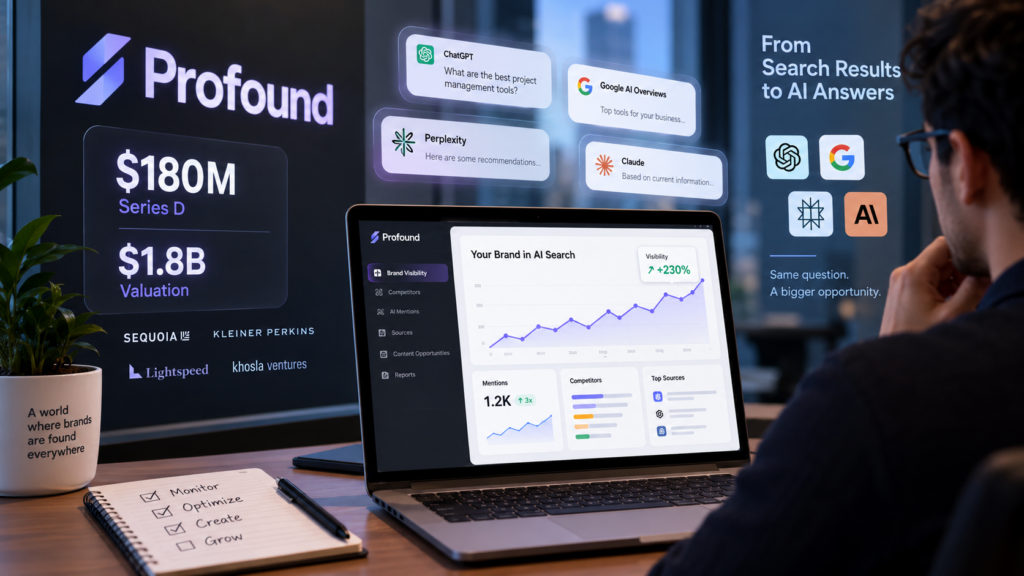
That question sits at the center of the business being built by New York-based startup Profound. Less than seven months after its previous $96 million funding round, the company announced a $180 million Series D at a $1.8 billion valuation on September 15, 2026. Existing investors Lightspeed Venture Partners and Khosla Ventures also participated, while Sequoia Capital and Kleiner Perkins co-led the latest round.
The funding is notable not only because of its size, but also because of what Profound is building: software designed for a digital marketing environment where AI search visibility is becoming an important part of how brands are discovered online.
Table of Contents
What Is Profound?
Founded in 2024, Profound initially focused on analytics that helped marketers understand how brands appeared across AI-powered search and answer experiences. The company has since expanded its platform to cover areas including marketing research, content and broader marketing workflows.
At a basic level, Profound helps companies understand how AI systems represent their brands.
For example, a company may want to know:
- Does ChatGPT mention its product when users ask for recommendations?
- How does an AI system describe the company?
- Which competitors appear in the same answers?
- What sources are influencing those answers?
- How visible is the brand across AI-powered search experiences?
These questions fall within the growing areas of Generative Engine Optimization (GEO) and Answer Engine Optimization (AEO).
Traditional SEO is largely focused on helping webpages appear in search-engine results. GEO and AEO look at another part of the discovery process: how brands, products and information are represented in AI-generated answers.
Why Did Profound Raise $180 Million?
Profound’s latest funding gives the company substantial capital to expand its platform and continue developing tools for marketers adapting to AI-powered search.
The company said the new funding will be used to expand its capabilities and develop its AI-powered marketing platform further.
The speed of Profound’s fundraising is also worth noting.
Its Series C round raised $96 million and valued the company at $1 billion. Less than seven months later, the new Series D has taken its valuation to $1.8 billion.
Profound said its revenue has tripled over the past six months and that it now serves more than 1,000 enterprise customers. These figures were provided by the company and should therefore be viewed as company-reported figures rather than independently audited financial results.
How AI Search Is Changing Brand Visibility
For years, digital marketing has revolved around a relatively straightforward question:
Where does my website rank in Google?
That question still matters, but AI is changing how users can discover information.
Consider someone searching for cybersecurity software. Instead of opening several search results and comparing different companies, they can ask an AI assistant:
“What are the best cybersecurity platforms for a mid-sized company?”
The response may provide a list of companies along with descriptions, comparisons and supporting sources.
For brands, that creates another layer of visibility to understand.
A company can have strong traditional search rankings while receiving limited visibility in AI-generated answers. At the same time, an AI system may recommend a company that does not have the same level of traditional search visibility.
This creates a new measurement challenge for marketing teams.
They now need to understand not only where their website ranks, but also how AI systems discover, interpret and describe their brand.
What Is Generative Engine Optimization (GEO)?
Generative Engine Optimization, commonly known as GEO, broadly refers to efforts aimed at improving a brand’s visibility and representation in generative AI experiences.
GEO is closely related to SEO, but the two are not identical.
Traditional SEO can involve optimizing webpages around search queries, improving technical performance, earning authoritative links and developing topical relevance.
GEO introduces additional questions that marketers need to consider.
How Does AI Understand a Brand?
Companies need to make sure important information about their business is accurate, consistent and clearly presented across authoritative online sources.
This can include company websites, documentation, reputable publications, industry resources and other sources that may help establish context around a brand.
Which Sources Influence AI Answers?
AI-generated answers can draw information from multiple sources, depending on the system and the type of query.
For marketers, understanding which sources are associated with their brand can therefore become an important part of AI-search visibility.
This is different from simply tracking a Google ranking for a particular keyword.
Is the Brand Being Represented Accurately?
Visibility by itself is not necessarily enough.
If an AI system mentions a company but provides outdated or incorrect information, the result can create a different problem for the brand.
That is why businesses have an incentive to monitor not only whether they appear in AI-generated answers, but also what those answers actually say about them.
Profound Is Expanding Beyond AI Search Monitoring
Profound’s latest direction suggests that the company wants to build something broader than an AI-search monitoring tool.
The company describes its platform as an AI-powered system for marketing teams, with capabilities covering research, content and marketing execution.
That distinction could be important as AI becomes more deeply integrated into marketing workflows.
A marketing team may eventually want one system that can:
- Identify the questions customers are asking AI systems.
- Track how the brand appears in AI-generated answers.
- Identify gaps or inaccurate information.
- Understand competitors’ visibility.
- Develop content and marketing strategies.
- Monitor changes in AI visibility over time.
That makes the opportunity potentially much larger than a standalone AI-search analytics dashboard.
Why Profound’s Funding Matters to SEO and Marketing Startups
Profound’s latest funding round also highlights the growing opportunity around search, content and marketing software.
The traditional SEO industry has developed over several decades. AI, however, is creating new categories around AI visibility, answer engine optimization, brand monitoring, content creation and marketing automation.
Profound is targeting one part of that emerging market.
Its $1.8 billion valuation does not, by itself, establish how large the overall GEO market will become. However, the size of the funding round and the company’s reported growth show that investors are putting substantial capital behind software designed for AI-driven discovery.
For marketers, the development does not necessarily mean that traditional SEO is disappearing.
Instead, search is becoming more fragmented.
Consumers can discover companies through traditional search engines, AI-generated answers, social platforms, marketplaces, online communities and other channels.
What This Means for the Future of AI Search Marketing
Profound’s funding round reflects a broader shift in the AI startup ecosystem.
Many startups are no longer focused solely on building another general-purpose chatbot. Instead, they are developing specialized software around the business problems created by increasingly capable AI systems.
Profound is applying that approach to marketing and search visibility.
The underlying question is becoming increasingly relevant for businesses:
When customers ask an AI system instead of searching the web themselves, where does your brand appear, and what does the AI say about it?
As AI-powered discovery continues to evolve, understanding that visibility could become an increasingly important part of digital marketing strategy.