Share This Article
Generative AI has made big waves in different business areas, including banking. Its ability to summarize documentation, generate answers, make predictions, and produce reports has created a wide range of opportunities for experimentation and innovation in banks and financial services.
In this article, we shall discuss the latest and most innovative use cases of generative AI in banking and financial services, their effectiveness, prospects, and scenarios where a generative AI consulting company can help a financial company reshape its tech stack.
Table of Contents
What Is Generative AI in Financial Services?
Generative AI models are capable of processing large amounts of data and generating new content based on information derived from these data chunks.
Banking and financial institutions are constantly dealing with big amounts of data, too. That includes investment research, investment claims, customer support tickets, legal documentation, compliance reports, risk assessments, market trend analysis, loan applications, and more.
Most of this data is processed manually, requiring many routine operations that are prone to error, so several employees must check the information.
Generative AI copes with these routine tasks exceptionally well.
In banking, it is used to generate customer responses, financial reports, investment summaries, fraud investigation summaries, risk assessments, personalized recommendations, and different sorts of documentation.
Below, we review these use cases in closer detail.
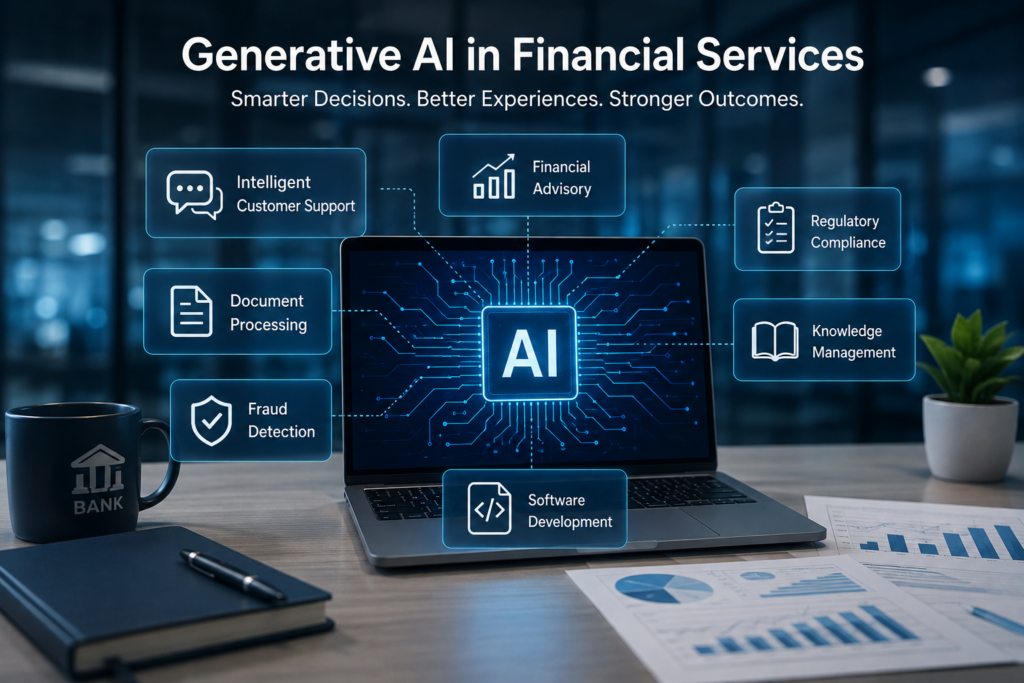
GenAI in Banking Use Case #1: Smart Bots and Intelligent Customer Support
GenAI bots can answer most common banking questions quite well. Usually, these are questions about loan products, mortgage applications, insurance claims, profile information, and credit card issues.
These bots can speak multiple languages and are available 24/7, which saves banks money. If the conversation becomes too complex for a bot, the bot redirects customers to live agents.
Despite GenAI bots being quite new, many banks use them widely.
GenAI in Banking Use Case #2: Intelligent Document Processing
The technologies of computer vision and deep learning enable GenAI applications to actually “read” tons of documents, process the information within them, summarize, extract the needed pieces, and generate reports based on the data stored in files.
Banks usually process a ton of documentation, including tax forms, loan applications, contracts, invoices, insurance policies, regulatory filings, KYC documents, and more.
GenAI applications process this information, identify missing fields, and generate structured reports, allowing banks to save employees from a lot of routine operations.
GenAI in Banking Use Case #3: Fraud Detection
Traditional fraud detection systems flag suspicious activities to bank employees, who review each case separately to establish whether the situation is real fraud.
AI helps generate better insights. AI algorithms process historical information, previous customer history, and more to provide bank employees with more context for fraud identification.
For example, a GenAI application can explain why the transaction seems suspicious. It provides information about previous customer activity, related accounts, historical information, and recommended investigation steps.
GenAI in Banking Use Case #4: Financial Advisory
Investment advisors spend a lot of time collecting context for client meetings. They need information about market developments, competition, and personal client financial information.
GenAI helps bank employees by generating portfolio summaries, flagging important market updates, preparing investment comparisons, providing personalized recommendations, collecting meeting notes, and reminding clients to send follow-up emails.
GenAI in Banking Use Case #5: Regulatory Compliance
The regulations are changing constantly. Banks keep big legal teams whose job is to follow changes in regulations and bring the bank’s internal procedures and documentation into compliance with them.
GenAI can help them in different ways. It summarizes new regulations, compares policy changes, identifies compliance gaps, runs audits, answers internal compliance questions from employees, generates policy drafts, and reduces manual research.
This way, compliance teams save time and respond to changes in regulations promptly.
GenAI in Banking Use Case #6: Internal Knowledge Management
Big organizations have complex internal documentation, and many employees often spend hours searching for answers to questions related to how the organization works from inside.
GenAI helps employees find answers to questions related to internal policies, technical documentation, legal guidelines, HR procedures, product manuals, and more.
A centralized system or an application in place often becomes a valuable assistant for bank employees that need fast consulting on internal processes.
GenAI in Banking Use Case #7: Developing Banking Software
In banking, software plays a special role, especially now, when companies have to compete in innovation and tech updates.
As new tech solutions affecting banking emerge every day, banks have to maintain and invest heavily in IT teams.
AI helps develop new products fast. Developers use GenAI to generate code, review software, explain legacy software, write documentation, automate testing, identify bugs, and more — making the whole process faster.
Summing Up
The development of generative artificial intelligence has already had a significant impact on the technological solutions used in banking, shaping what banking services look like. These applications allow bank employees to complete most procedures faster and be more flexible in adopting innovations.

Prashant Sharma
Prashant Sharma is a Delhi based Entrepreneur who spent most of his college days polishing his marketing skills and went for his first business venture at 19. Having tasted failure in his entrepreneurial debut, he turned a Tech-enthusiast, specializing in web technologies later. Join him on Google Plus