Share This Article
In the first 90 days of 2026, Bitcoin was stuck near the same price level for 43 days, fluctuating no more than 4% up or down. For manual traders staring at candlestick charts, this kind of market is practically a lullaby. But for an automated grid strategy, this is precisely the battlefield where it excels.
This article mainly talks about BYDFi’s trading bot suite. The exchange BYDFi started in 2020 and has been running steadily for over six years, even surviving that crypto winter wave of 2022. They have built four automated strategies specifically designed to tackle that kind of lifeless, directionless market.
Table of Contents
Conclusion first
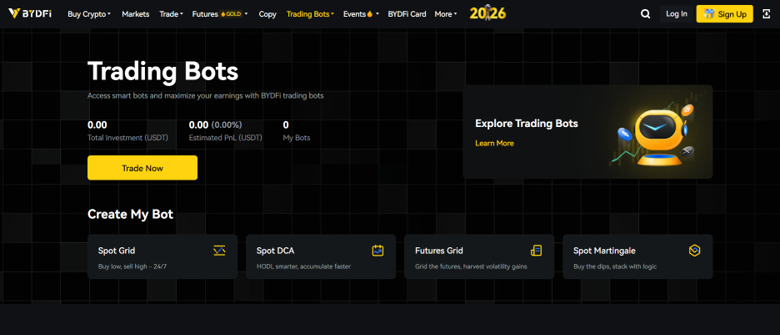
BYDFi currently offers four types of trading bots: Spot Grid, Spot DCA, Futures Grid, and Spot Martingale. The Spot Grid robot works best during range-bound market oscillations, while the other three serve as complementary tools for staged position building and leveraged trading respectively.
The platform has accumulated over one million users across more than 190 countries, and its trading bots constitute a core component of its product ecosystem. If you are looking for ways to automate your trading account during sideways market phases, BYDFi’s suite of trading bots is well worth exploring.
Why Sideways Markets Favor Trading Bots
As the crypto market matures, long stretches of sideways price action are becoming the norm. Holding spot barely moves the needle, and manual swing trading rarely justifies the screen time.
Bots fill this gap by automatically buying low and selling high within a set range, stacking small but consistent profits. This shift isn’t temporary — institutional inflows via ETFs are smoothing out the volatility of the past. That’s exactly the future BYDFi is betting on with its Spot Grid bot.
Spot Grid: The Core Weapon for Sideways Consolidation
Among all BYDFi bots for sideways crypto markets, the spot grid is the most well-honed tool the platform has developed.
To put it simply, within a price range, the bot automatically buys low and sells high for you. The range can be divided into 2 to 99 small grids; when the price falls to a lower grid, it buys, and when it rises to an upper grid, it sells.
Based on actual testing, three points stand out the most:
No liquidation risk here. It runs on spot, not leveraged contracts, so liquidations simply aren’t a thing. You’re just trading real coins.
The AI can also help dial in your parameters. It suggests grid setups based on historical backtests. We tested it with BTC/USDT, and the AI recommendations were pretty solid—they caught the recent consolidation range nicely. Manual setup is still fully available if you prefer, but the AI saves a ton of effort.
The Other Three Bots That Work Together
Spot DCA is the simplest one: set the schedule, make a purchase every day or week, and let it run across 100+ trading pairs. When the price drops, it automatically buys more, lowering the average entry cost. This is the most hands-off “one-click automation” approach.
Spot Martingale is more aggressive: the lower the price goes, the more it buys, increasing the position size along the way. The strategy bets that the price will eventually bounce back and aims to make a profit when the rebound comes. The trade-off is that you need strong risk tolerance and confidence that the asset will not go to zero.
Futures Grid takes the grid strategy and applies it to perpetual contracts, using leverage to capture market volatility. BYDFi supports leverage from 1x to 200x, and Futures Grid can use the full range. However, the risk level is completely different from Spot Grid.
Copy Proven Homework: Marketplace, Demo & Copy Trading
Every user gets a 50,000 USDT demo account. It uses real market data. You can run a grid bot for a week. Watch how often it trades, and check your net profit after fees. Then decide if you want to commit real funds.
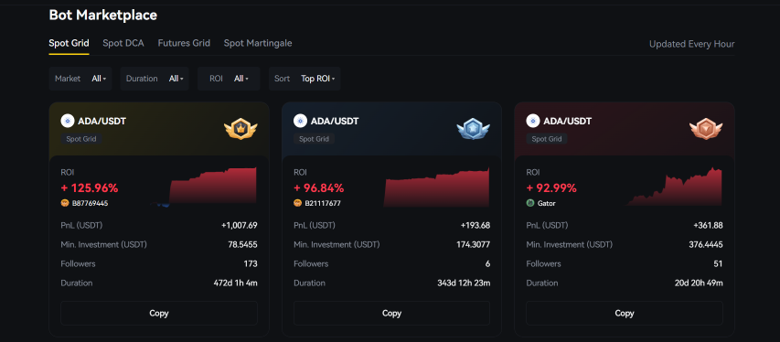
The bot marketplace shows strategies others have already tested. You can see their past performance and deploy them with one click — no need to set parameters yourself. If you’re just starting out, find a spot grid with a solid track record, get it running, and learn to tweak it as you go.
One caveat: past performance doesn’t guarantee future results; a configuration that worked well in a sideways market may stall when conditions change.
If you prefer not to set up bots at all, copy trading mirrors professional traders’ moves with one click, featuring proportional position scaling and independent risk isolation.
Fee Math: Get It Straight
Spot grid: each buy order costs 0.1%, each sell order 0.1%. On a single trade, that doesn’t look expensive. But a 50-level grid running a full cycle will trigger 100 fee events. The narrower the range, the thinner the per-level profit — and the more fees can eat into your gains.
If you’re trading futures grids, the rates are 0.02% maker and 0.06% taker. The higher your VIP tier, the bigger the discount, up to 60%. When you’re running several futures grids at once, your volume goes up, and that VIP discount is yours to use — unless you decide not to.
During our tests, we didn’t run into any hidden spread traps, but on low-liquidity, obscure coins, always glance at the order book before placing an order. Slippage is the kind of thing that strikes the moment you let your guard down.
Is BYDFi actually reliable?
BYDFi is licensed across multiple jurisdictions. Its reserve funds are audited and verified by Hacken. In August 2025, it landed a multi-year sponsorship with Premier League side Newcastle United, becoming the club’s official crypto trading partner.
A bit of background on Newcastle United. The club was founded in 1892. Its home, St James’ Park, holds over 50,000 fans. It’s owned by Saudi Arabia’s Public Investment Fund. A partnership with a historic top-flight club like that says a lot. It signals real long-term commitment and institutional credibility.
Is this platform right for you?
You’ll love it if:
- You trade actively and want bots to grind through those flat, sideways markets.
- You’re moving up from manual spot trading and ready to automate.
- You want a 50K USDT demo fund to test strategies before risking real cash.
- You’d rather copy a setup the community already trusts than build configs from zero.
Skip it if:
- You’re a set-and-forget investor who never tweaks a thing.
- You expect guaranteed, risk-free profits. (That’s not how this works.)
- You want a pure bot-only platform. BYDFi is a full exchange — bots are just one piece of it.
FAQ
What types of bots does BYDFi have?
Four: spot grid, spot DCA, futures grid, and spot Martingale. For sideways consolidation, spot grid is the go-to choice.
Can I practice without losing real money?
Yes. The platform provides 50,000 USDT in simulated funds, with market data synced to live prices.
How much are spot grid fees?
0.1% per buy order, 0.1% per sell order. Because the number of trades is high, you need to factor the fees in when you tally up the total.