Share This Article
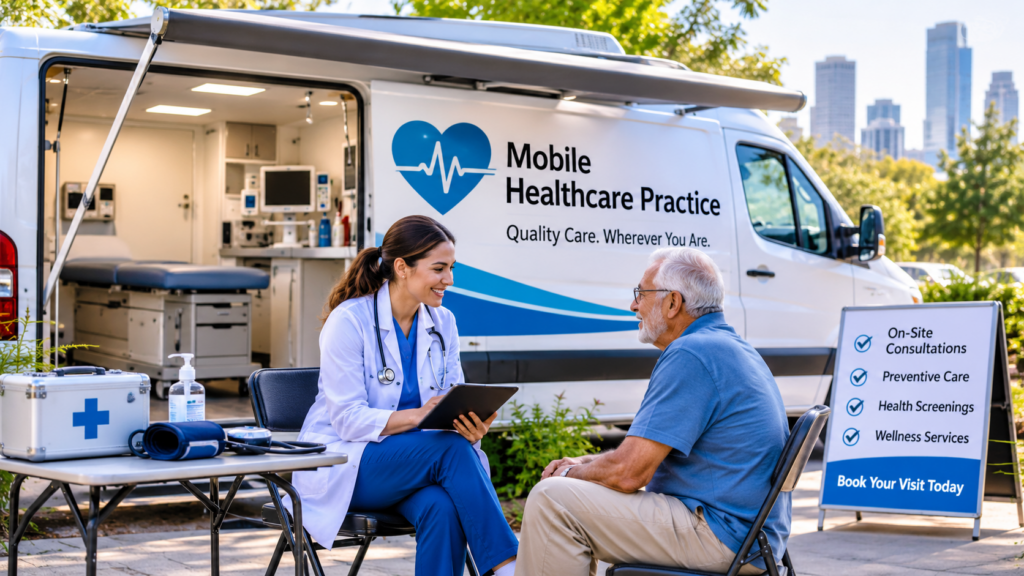
You have the license, the clinical skills, and a list of patients who struggle to reach a traditional office. What you don’t have is a building, and maybe you don’t want one. Launching a mobile healthcare practice lets you take care of the patient instead of waiting for the patient to find you. The clinical work stays familiar. The business decisions, from the vehicle you drive to the way people find you, change completely.
TL;DR: A successful mobile healthcare practice rests on three pillars: the right vehicle and equipment, dependable logistics for supplies and specimens, and marketing that tells patients exactly where you’ll be. Start with a vehicle that fits your specialty and budget, secure your licensing and insurance before you buy anything expensive, and build a booking and social presence that turns a moving clinic into a familiar one.
Table of Contents
Start With the Vehicle: The Decision That Shapes Everything Else
Your vehicle is your exam room, your waiting area, and your storefront. Get it wrong, and every other part of the business suffers.
Most new practitioners face a choice between a custom medical coach and a converted recreational vehicle. Custom builds from manufacturers like Odulair or Craftsmen Industries deliver purpose-built interiors, but Biz2Credit puts the starting cost of a full mobile clinic vehicle at around $300,000. That number sinks a lot of solo practices before they see a single patient.
A converted motorhome changes the math. Browsing a used RV for sale from a rental fleet often gets you a well-maintained Class C unit with a documented service history at a fraction of a custom build’s price. Rental companies service their vehicles on strict schedules, so you inherit a chassis that someone has already looked after.
Match the vehicle class to your specialty:
| Vehicle Type | Best For | Key Tradeoff |
|---|---|---|
| Cargo or Sprinter van | House calls, IV therapy, phlebotomy | Limited space for patients inside |
| Class B camper van | Solo chiropractors, massage therapists, vets | Tight standing room |
| Class C motorhome | Chiropractic, primary care, wellness screenings | Needs larger parking spots |
| Class A motorhome or trailer | Multi-provider clinics, dental, imaging | Highest fuel and insurance costs |
Before you sign anything, check interior ceiling height, floor strength for a treatment table, and whether the layout can fit a wheelchair ramp or lift. Accessibility under the ADA isn’t optional, and retrofitting it later costs far more than planning for it now.
Licensing, Insurance and Compliance Come Before Equipment
Here’s the trap many founders fall into: they buy the vehicle, outfit it, and then discover their state or county requires permits they can’t get for months.
Flip that order. Contact your state licensing board first and ask specifically about mobile practice rules, since some states treat a vehicle as a separate practice location that needs its own registration. Then check with city and county offices about where you can legally park and treat patients. Commercial lots, churches, community centers, and employer campuses often welcome a mobile clinic, but you need written permission for each site.
Insurance deserves its own budget line. A mobile practice typically carries:
- Professional liability (malpractice) coverage
- General liability for the vehicle as a place of business
- Commercial auto insurance, since a personal auto policy won’t cover business use
- Equipment coverage for anything bolted into the vehicle
HIPAA applies on wheels exactly as it does in a building. That means private treatment space, secure storage for any paper records, and encrypted devices for anything digital. If a patient’s chart lives on a tablet, that tablet needs a password, encryption, and remote wipe capability in case someone breaks into the vehicle overnight.
For additional information, refer to the U.S. Department of Health and Human Services HIPAA guidance.
Equipment Essentials for a Practice on Wheels
What does a clinic actually need when every pound and every outlet counts? Less than you think, but each item has to earn its spot.
Clinical equipment. Start with the tools specific to your specialty. A mobile chiropractor needs a sturdy adjusting table that locks into the floor. A primary care provider needs a mounted exam table, diagnostic kit, scale, and point-of-care testing devices. Portable ultrasound units from brands like Butterfly Network now fit in a coat pocket and connect to a smartphone, which opens up imaging that once required a full room.
Power and climate. Medical devices hate power fluctuations. Plan for an onboard generator, a pure sine wave inverter to protect sensitive electronics, and shore power capability for sites that offer an outlet. Climate control matters just as much: vaccines, medications, and some test kits need stable temperatures, so a medical-grade refrigerator with a temperature logger belongs on your list.
Connectivity and software. Your practice management system is your front desk now. Choose cloud-based EHR and scheduling software that runs reliably on a cellular connection, and back it up with a dedicated mobile hotspot from a different carrier than your phone. When one network drops in a rural parking lot, the other often holds. Pair it with a card reader that can process payments offline and sync later.
For more information about modern healthcare technology, read our article on the next generation of digital tools in healthcare.
Once the vehicle can treat patients safely, the next challenge is keeping it stocked and connected to the rest of the healthcare system.
Logistics: Routes, Supplies and Specimens
A fixed office receives deliveries at the same address every day. A mobile practice has to plan where its supplies meet it.
Route planning drives everything. Research published in the International Journal for Equity in Health found that U.S. mobile clinics deliver a median of 3,491 visits a year, which works out to roughly 65 to 70 visits a week. Hitting that kind of volume requires clustered scheduling. Group patients by neighborhood, set a predictable weekly rotation, and use routing tools like Route4Me or the built-in optimization in many practice management platforms to cut wasted drive time.
Supply chain works differently on the road. Keep a base location, whether a small storage unit or a partner office, where bulk supplies arrive and where you restock between routes. For anything urgent, a local courier service bridges the gap between your base and wherever the vehicle sits that day.
Specimens raise the stakes further. Blood draws, cultures, and other samples often have tight windows for reaching a lab, and they need proper temperature control and chain of custody documentation. A courier experienced in medical deliveries can pick up specimens directly from your parking spot and get them to the lab on time, so you don’t have to break your patient schedule to make a drop-off yourself.
Plan your vehicle maintenance with the same discipline. Book oil changes, tire rotations, and generator servicing on days off, and keep a relationship with a mechanic who works on RVs or commercial vans. One unplanned breakdown can cancel a full day of appointments.
Marketing a Practice That Moves
A brick-and-mortar clinic has a sign, a street address, and years of foot traffic. Your clinic has none of that, which makes marketing the difference between a full schedule and an empty parking lot.
Start with your online presence. Patients will search for you before they book, so you need a simple website with online scheduling, a clear service area map, and a published weekly route. Claim your Google Business Profile and list it as a service area business, which lets you show up in local results without displaying a fixed address.
Refer to Google’s Business Profile guidelines for eligibility and address representation requirements.
Social media does the heavy lifting from there. A moving clinic has something most offices don’t: built-in stories. Post where the vehicle will be this week, share short videos of the interior setup, introduce your team, and answer common patient questions on camera. Healthcare marketing firms like iMatrix have documented what effective social media marketing looks like for chiropractors and similar practices: consistent posting, educational short videos, and real patient stories build trust faster than polished ads.
A few tactics work especially well for mobile providers:
- Location announcements. Post each stop on Instagram and Facebook stories the morning you arrive, and tag the host business so they share it too.
- Host partnerships. Gyms, senior living communities, and corporate campuses make ideal hosts. They get a wellness perk for their members, and you get a captive audience.
- Review requests. Text patients a review link right after the visit while the experience is fresh. Reviews matter even more when patients can’t judge you by your office.
- Vehicle wraps. Your RV is a moving billboard. A clean wrap with your name, specialty, and booking link turns every drive into an impression.
Track which channels actually bring bookings, then put more effort into the ones that work.
Mistakes That Stall New Mobile Practices
Plenty of mobile practices fail for reasons that have nothing to do with clinical skill. These patterns show up again and again:
- Buying the vehicle first. Secure licensing, insurance, and at least two host sites before you commit to a vehicle.
- Underestimating parking. A Class A motorhome that can’t fit in your host’s lot is an expensive driveway ornament.
- Ignoring billing setup. Insurance credentialing can take months. Many mobile chiropractors start cash pay and provide superbills so patients can file claims themselves.
- Skipping a backup plan. Have a list of alternate sites and a process for rebooking patients when weather or a breakdown cancels a day.
- Inconsistent schedules. Patients forgive a moving clinic. They don’t forgive one they can never find.
For additional business security practices, read our guide on the cybersecurity checklist for businesses.
What Year One of a Mobile Healthcare Practice Really Looks Like
The first year of a mobile practice rarely matches the plan on paper. Routes change as you learn which neighborhoods book well. Equipment that looked essential sits unused while a cheap item you overlooked becomes indispensable. That’s normal, and it’s actually the model’s biggest advantage: a practice on wheels can adjust its location, hours, and services far faster than one tied to a lease.
The providers who succeed treat launching a mobile healthcare practice as three businesses running together. One delivers care. One manages a small logistics operation. One markets a brand that literally moves. Give each of those businesses the same attention you give your patients, and the vehicle stops being a novelty and becomes the place your community trusts for care.
FAQs
How much does it cost to start a mobile healthcare practice?
Costs vary widely by specialty and vehicle. A van-based house call practice can launch for a modest investment, while a custom-built medical coach often starts around $300,000. A converted used motorhome typically lands between those two, with equipment, insurance, and licensing added on top.
What type of vehicle works best for a mobile chiropractic practice?
Most mobile chiropractors choose a Class B camper van or a Class C motorhome. Both offer enough room for an adjusting table and a private treatment area while still fitting in standard commercial parking lots.
How do mobile clinics handle lab samples and medical supplies?
Most mobile clinics keep a fixed base for bulk supplies and rely on medical couriers to move specimens to labs and deliver urgent supplies to the vehicle. This keeps the clinic on schedule without extra trips.
Can a mobile healthcare practice accept insurance?
Yes. Mobile practices can credential with insurers just like fixed offices, though the process takes time. Many start with cash pay and superbills, then add insurance billing once credentialing is complete.