All businesses that are scaling eventually come to realize that their technology is no longer an advantage but a limitation. The combination of off-the-shelf tools, spreadsheets, and disconnected systems that worked well in the beginning begins to crack under real volume. Orders are slowing down. Data is locked in silos. Teams spend more time fighting their software than they do using it.
This is the place where scalable, enterprise-grade applications transition from a nice-to-have to a core driver of growth. Companies that regard software as a strategic asset, rather than a cost to minimize, tend to outpace competitors who keep bolting on quick fixes. That change is increasingly forcing companies to build integrated, custom platforms around the way they actually work.
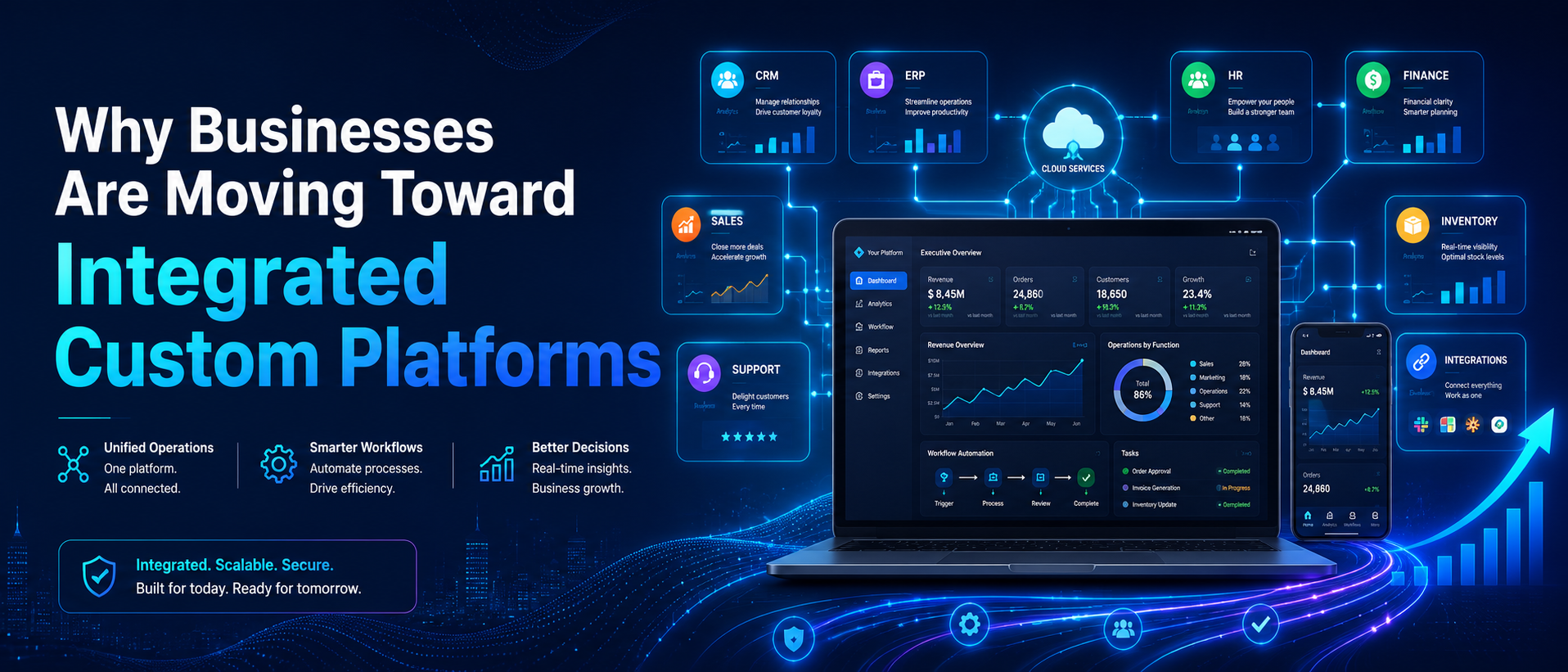
Many companies start with custom software development services built around their specific workflows instead of trying to fit their operations into a one-size-fits-all product. The point is not simply to digitize tasks. It is to build a foundation that can absorb growth, adapt to change, and connect every part of the business into one coherent system.
Stalled growth is often caused by bad software architecture. When systems aren’t built for scale, little inefficiencies compound. A process that is working well at a hundred transactions a day falls apart at ten thousand. Broken Integrations. Costs go up. And each new feature is harder to add than the last.
Another pressure comes from customer expectations. As more interactions move to mobile, businesses are applying this same architectural discipline to custom mobile application development services, where speed, reliability and a smooth experience are direct drivers of how people perceive the brand. Getting the foundation right early on is a lot cheaper than rebuilding it later.
Table of Contents
Features of Enterprise Grade Applications
Not all software is enterprise-grade. The term stands for a particular set of qualities which allow an application to perform under real business pressure.
• Scalability
The system must be able to scale with users, data and transactions without degradation in performance or requiring a complete re-build. Scalability is built in from the beginning, not patched in after the pain shows up.
• Safety
Enterprise applications protect sensitive data in several layers: access controls, encryption and compliance with relevant standards. One breach can wipe out years of trust, so we see security as a base, not an add-on.
• Performance
Time is critical. Slow load times, laggy interfaces frustrate users and reduce productivity. Robust systems remain responsive as demand climbs.
• Dependability
Downtime costs money. Enterprise software is designed for high availability. Failovers, monitoring, and similar measures keep things running smoothly when something goes wrong.
• Integration Capabilities
There are many tools used to run modern business. An enterprise application connects easily with existing systems, payment gateways, CRMs, analytics platforms, and third-party services, allowing information to flow freely rather than getting stuck.
Together, these qualities are what differentiate software that just works today from software that continues to work as the business changes.
Core Pillars for Long Term Growth
Building for the long term is about architectural decisions that pay off over years, not weeks.
• Modular Architecture
The biggest decision is whether to build a monolith or go microservices. A monolith keeps all its information in one codebase, which can make it easier to start but harder to update and scale over time. Microservices break the system down into independent units that can be developed, deployed and scaled independently. A modular approach is often more flexible and resilient for expanding businesses, but the right choice depends on team size and complexity.
• Cloud Native Development
Building for the cloud gives businesses flexibility. Resources surge at peak demand and decrease during lulls, controlling costs and improving reliability. The cloud-native design also allows for faster deployment and easier global reach.
• Data Driven Decision Making
A well-architected platform collects clean, usable data across the organization. The organization uses that data to make better decisions, from predicting demand to understanding customer behavior. Data is still fragmented, and without solid architecture its value is lost.
• Automation and AI Readiness
Systems have been designed to be future-ready and structured to allow artificial intelligence to be layered in when the time is right, with automation in mind. It’s much easier to adopt AI later with a clean data pipeline and a modular design than to retrofit AI onto a rigid system.
Common Mistakes Businesses Make
Even the most well-intentioned technology investments go wrong in predictable ways.
• A Short-Term Development Perspective
Focusing only on the immediate launch often leads to costly problems later. Rushing to ship means rebuilding core systems in a year or two.
• Ignoring Scalability Early On
Many teams don’t think about scale until they are in a crisis. Retrofitting the system by that time is expensive and disruptive. It’s a lot cheaper to plan for growth from day one than to react to it under pressure.
• Choosing the Wrong Technology Stack
If they choose technologies based on trends rather than fit, a business may find itself with tools that are difficult to hire for, poorly supported, or simply do not meet its needs. The right stack is a balance of performance, talent availability, and longevity.
Best Practices for Building Future-Ready Applications
Avoiding those mistakes requires a few disciplined habits.
• Plan Ahead
Don’t start without a plan. Clear goals, requirements, and a realistic roadmap help avoid wasted effort. The technical decisions we make today should reflect where the business wants to be in three to five years.
• Pick the Right Development Partner
The technology is important, but so is the team behind the platform. A good partner brings architectural experience, asks hard questions, and guides the project away from costly missteps. An expert consultation can be useful here, helping decision-makers think through trade-offs they might not otherwise consider.
• Commit to Continuous Improvement
Software is never finished. The best platforms improve through ongoing iteration, informed by real usage data and changing business needs. The application is a living system, not a project—and this makes it valuable over time.
A Practical Example
Consider a mid-sized retail company that had grown through a collection of separate tools for inventory, sales, and customer management. As more orders poured in, the disconnected systems resulted in delays, stock errors, and frustrated customers. Staff manually entered data between platforms, creating errors and costing hours every week.
The firm made a capital investment in a custom integrated platform based on a modular cloud-native architecture. All the inventory, sales, and customer data now existed in one integrated system. What used to be manual handoffs, now it’s automated. The platform scaled smoothly through a busy holiday season that would have swamped the old system.
The results were conclusive. Order processing time was reduced, mistakes were reduced and the team could work on growth instead of fighting fires. Equally important, the new architecture provided the business room to add features and expand without starting over. The initial investment paid for itself by removing the ceiling that suboptimal architecture had surreptitiously imposed.
Conclusion
Technology should be a multiplier for a business and not a limiter. The difference between success and failure for companies as they grow is often the quality of the systems below them. Integrated custom platforms built on scalable, secure and well-architected foundations give the flexibility to grow, adapt and compete.
The ones that are backing away are the ones that think of software as a long-term investment, not a short-term cost. They plan for scale early, they pick their architecture with intention and they work with partners that understand both technology and business value.
Investing in a well-built platform is not purely a technical decision. It’s a strategic one that dictates the speed and distance a business can go. For leaders looking to deploy their resources, few decisions offer a better long-term return on investment than getting the digital foundation right.