Share This Article
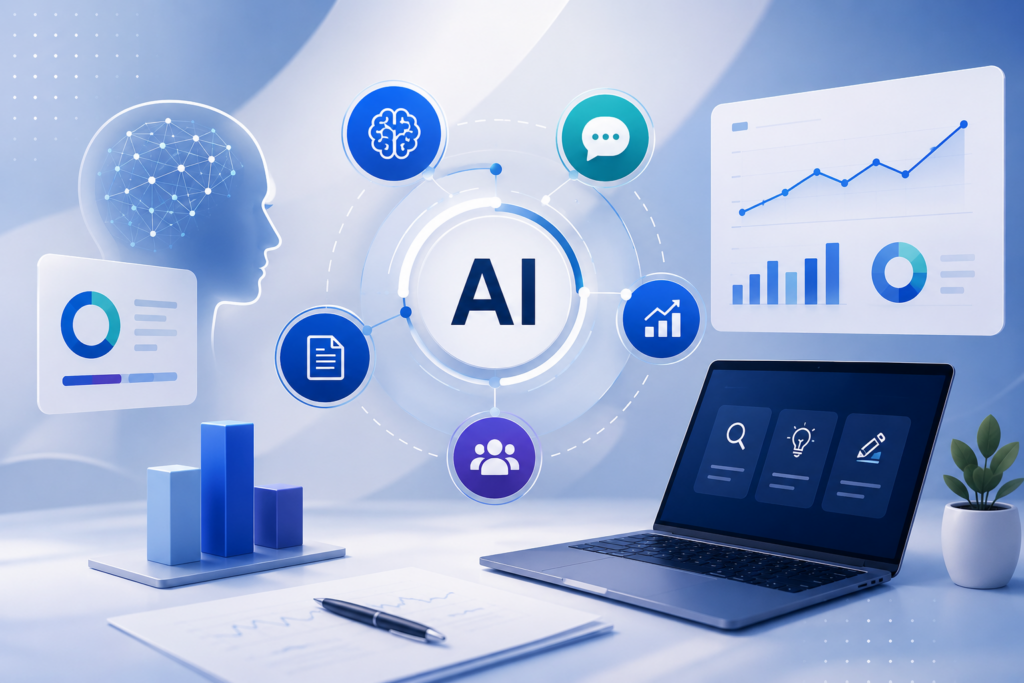
Artificial intelligence has gone from a niche technology discussed by researchers to a mainstream tool used by students, professionals, entrepreneurs, developers, marketers, and everyday consumers. Yet amid all the excitement surrounding AI, one question remains surprisingly difficult to answer: How do people actually use AI in the real world? The headlines often focus on breakthrough models, billion-dollar investments, and futuristic predictions. However, the real story is hidden inside millions of conversations taking place every day across AI platforms.
The latest AI usage statistics reveal that people are using artificial intelligence in ways that are often very different from what experts predicted just a few years ago. Instead of replacing human workers overnight, AI has become something far more practical: a digital partner that helps people think, learn, create, research, communicate, and make better decisions. As we move deeper into 2026, examining AI usage statistics offers valuable insight into how society is adapting to one of the most significant technological shifts since the rise of the internet.
keyword has become central to understanding these shifts, as analysts track every interaction to map real behaviors.
Table of Contents
The Explosion of AI Adoption
Few technologies in history have experienced adoption as rapidly as generative AI. When ChatGPT launched publicly in late 2022, many observers expected AI to remain a specialized tool used primarily by developers and technology enthusiasts. That prediction proved spectacularly wrong. Today, AI tools have become part of everyday workflows for millions of people worldwide. Recent AI usage statistics show that adoption is accelerating across nearly every demographic group, from students and freelancers to executives and large enterprises.
Several factors explain this rapid growth: ease of use, natural language interaction, improved accuracy, accessibility across devices, and growing integration into existing software. Unlike earlier technological innovations that required extensive training, modern AI systems can be used almost immediately. Anyone who can ask a question can use AI. This simplicity has dramatically lowered the barrier to entry and fueled unprecedented AI adoption.
To reach deeper insights, researchers examine patterns where keyword appears frequently in user prompts, highlighting how people frame their needs. Another layer emerges when keyword analysis reveals common themes across sessions.
One of the most fascinating findings emerging from modern AI usage statistics is that people increasingly use AI as an extension of their thinking process. Historically, computers were primarily tools for calculation and information storage. Today’s AI systems serve a different purpose. People use them to organize thoughts, brainstorm ideas, explore alternatives, summarize information, make decisions, and learn new concepts.
In many cases, users already know the information they need. Their challenge is processing large amounts of data quickly and effectively. AI acts as a cognitive amplifier. Rather than replacing intelligence, it enhances it. This shift may ultimately become one of the most important developments in the evolution of human-computer interaction.
Expanding on this, countless users report treating AI like a trusted advisor. They input complex scenarios and receive structured outputs that clarify their own reasoning. This collaborative dynamic appears repeatedly in aggregated AI usage statistics, showing sustained growth in reflective and iterative conversations.
keyword surfaces often when users optimize their queries for better results.
Writing Remains the Dominant Use Case
Despite discussions about autonomous agents and AI-powered automation, writing continues to dominate usage patterns. According to various AI usage statistics, content generation remains one of the most common activities across AI platforms. Users rely on AI for emails, reports, blog posts, presentations, marketing campaigns, product descriptions, social media content, and business proposals.
The reason is simple. Writing is central to modern work. Whether someone works in marketing, education, finance, healthcare, technology, or sales, communication plays a crucial role in daily responsibilities. AI significantly reduces the time required to move from idea to finished content. Tasks that previously consumed hours can now be completed in minutes. This productivity boost is one of the strongest drivers behind ongoing AI adoption.
Further data indicates that polished drafts emerge faster when users combine their expertise with AI suggestions. Professionals iterate multiple times, refining tone, structure, and clarity. In enterprise settings, entire teams coordinate around AI-assisted documents, streamlining approval workflows and reducing revision cycles. These patterns reinforce why writing-related interactions top the charts in comprehensive AI usage statistics reviews.
Additional expansion on this use case reveals that hybrid human-AI writing processes yield higher engagement metrics on published content. Audiences respond better to clear, well-organized material produced with AI support.
Students Are Among the Biggest Beneficiaries
Students represent one of the fastest-growing categories of AI users. Popular media often portrays AI as a shortcut for completing assignments. While misuse certainly exists, the broader reality is much more interesting. Students increasingly use AI as a tutor, a study companion, a research assistant, a language coach, and an exam preparation tool.
Unlike traditional educational resources, AI adapts its explanations based on individual needs. If a student struggles with a concept, the AI can simplify the explanation. If the student requires advanced detail, the AI can provide deeper analysis. This personalized learning experience helps explain why educational applications consistently rank among the most common categories found in AI usage statistics.
Case studies from universities show improved retention rates when students leverage AI for spaced repetition, concept mapping, and practice testing. International students particularly benefit from language support features, breaking down barriers in non-native academic environments. These trends continue to evolve, with AI usage statistics projecting even stronger growth in the education sector through the late 2020s.
The Rise of AI in Professional Workflows
Perhaps the most transformative trend emerging from AI usage statistics is the growing integration of AI into professional environments. Organizations increasingly use AI to improve efficiency across departments. Marketing teams use AI to generate content and analyze campaigns. Sales teams use AI to prepare outreach strategies. Human resources departments use AI to draft job descriptions and summarize candidate information. Customer service teams use AI to improve response quality and reduce resolution times. Meanwhile, executives rely on AI to summarize reports, analyze data, and evaluate strategic opportunities.
Rather than eliminating jobs, AI is increasingly becoming a productivity multiplier. Professionals who understand how to use AI effectively often outperform those who ignore it. Detailed breakdowns in industry reports illustrate department-wide gains: faster turnaround on deliverables, reduced administrative burden, and more time allocated to high-value strategic work.
keyword integration in training programs helps teams maximize these benefits.
Developers Have Embraced AI Faster Than Anyone Else
Software development has emerged as one of the most successful AI use cases. Developers use AI for code generation, debugging, documentation, learning new languages, reviewing code, and refactoring existing projects. Modern AI tools can generate functional code within seconds, dramatically reducing development time. However, experienced developers understand that AI works best as a collaborator rather than a replacement. The most productive developers use AI to eliminate repetitive work while focusing their own expertise on architecture, problem-solving, and strategic decision-making.
This collaborative model explains why developers continue to rank among the most enthusiastic AI users globally. Open-source communities share prompt libraries and fine-tuning techniques, accelerating collective progress. AI usage statistics from coding platforms demonstrate shorter commit cycles and fewer bugs in AI-assisted repositories.
Search Is Undergoing a Massive Transformation
One of the most significant AI trends in 2026 involves search behavior. Traditional search engines require users to perform multiple steps: search for information, open several websites, compare sources, evaluate credibility, and draw conclusions. AI simplifies this process. Users increasingly prefer asking complex questions and receiving synthesized answers.
For example, instead of searching for multiple articles about project management software, a user can simply ask: “Which project management platform is best for a remote startup with 25 employees and a limited budget?” The AI analyzes relevant information and provides a concise recommendation. This represents a shift from information retrieval to information synthesis. The implications for publishers, marketers, and search engines are enormous.
keyword optimization strategies are adapting to conversational search patterns.
AI Is Changing How People Learn
The traditional learning model often relies on one-size-fits-all educational materials. AI introduces a fundamentally different approach. Users can ask unlimited questions, request alternative explanations, learn at their own pace, and explore topics interactively. This flexibility creates a highly personalized educational experience. As a result, educational interactions continue to represent a major category within global AI usage statistics. Many experts believe this trend could significantly reshape education over the coming decade.
Lifelong learners in professional fields use AI to stay current with rapidly evolving domains like data science, digital marketing, and sustainable technologies. Interactive simulations and real-time feedback loops make complex subjects more approachable.
Emotional and Personal Support Is Growing
One surprising trend revealed by AI usage statistics involves emotional support conversations. Many users turn to AI for help with stress management, career planning, goal setting, personal development, relationship challenges, and decision-making. AI is not a substitute for professional therapy or human relationships. However, many people appreciate having access to a non-judgmental conversational partner available at any time.
The popularity of these interactions highlights a broader reality: People often need structured thinking more than direct answers. AI excels at helping users organize thoughts and explore possibilities. Anonymized data shows peaks in usage during evening hours and weekends, when traditional support services may be less accessible.
keyword tracking in these sessions underscores the value of reflective dialogue.
AI Is Creating a New Productivity Gap
Throughout history, technological advances have created advantages for early adopters. AI appears to be following the same pattern. Professionals who effectively integrate AI into daily workflows frequently report faster research, improved communication, better organization, enhanced creativity, and greater productivity. As adoption increases, AI literacy is becoming an increasingly valuable skill. Just as internet literacy became essential during the digital revolution, AI literacy may become equally important during the coming decade. Those who understand how to collaborate with AI effectively will likely gain a significant competitive advantage.
Organizations investing in upskilling programs report measurable ROI through higher output quality and employee satisfaction. The productivity gap manifests in career progression, with AI-proficient individuals securing promotions and interesting projects at higher rates.
The Future of AI Usage
The next phase of AI adoption will likely look very different from the first. Initially, people experimented with AI out of curiosity. Today, they use it to solve real problems. In the future, AI will become deeply integrated into everyday tools and workflows. We are already seeing AI embedded into search engines, office software, smartphones, customer support platforms, design applications, and communication tools.
As AI becomes more invisible, adoption will continue to rise. Users may eventually stop thinking about AI as a separate technology altogether. Instead, it will become part of the digital infrastructure that powers modern life. Forward-looking AI usage statistics forecast multi-modal interactions combining text, voice, image, and video inputs for richer experiences.
keyword appears in forward projections as analysts model sustained growth trajectories.
What the AI Usage Statistics Really Tell Us
When examining modern AI usage statistics, it becomes clear that the biggest story is not automation. It is augmentation. People are not primarily using AI to replace themselves. They are using AI to become more capable versions of themselves. Across industries and demographics, the most common applications revolve around three core activities:
Thinking
AI helps users analyze information, explore ideas, and make decisions.
Learning
AI provides personalized educational experiences and instant explanations.
Creating
AI accelerates writing, coding, design, and content production.
These functions explain why AI adoption continues to expand at an extraordinary pace. Additional nuances emerge when examining longitudinal data: users who engage weekly show compounding skill improvements over months.
Final Thoughts
The latest AI usage statistics paint a fascinating picture of how society is adapting to artificial intelligence. Rather than replacing human intelligence, AI is increasingly acting as a force multiplier for human potential. People use AI to learn faster, write better, work smarter, and make more informed decisions. The most successful users are not those who rely entirely on AI. They are those who understand how to collaborate with it.
As AI continues to evolve, the gap between users who embrace these tools and those who ignore them will likely widen. The story of AI in 2026 is not about machines becoming human. It is about humans gaining new capabilities through machines. And if current AI usage statistics are any indication, this transformation is only just beginning.